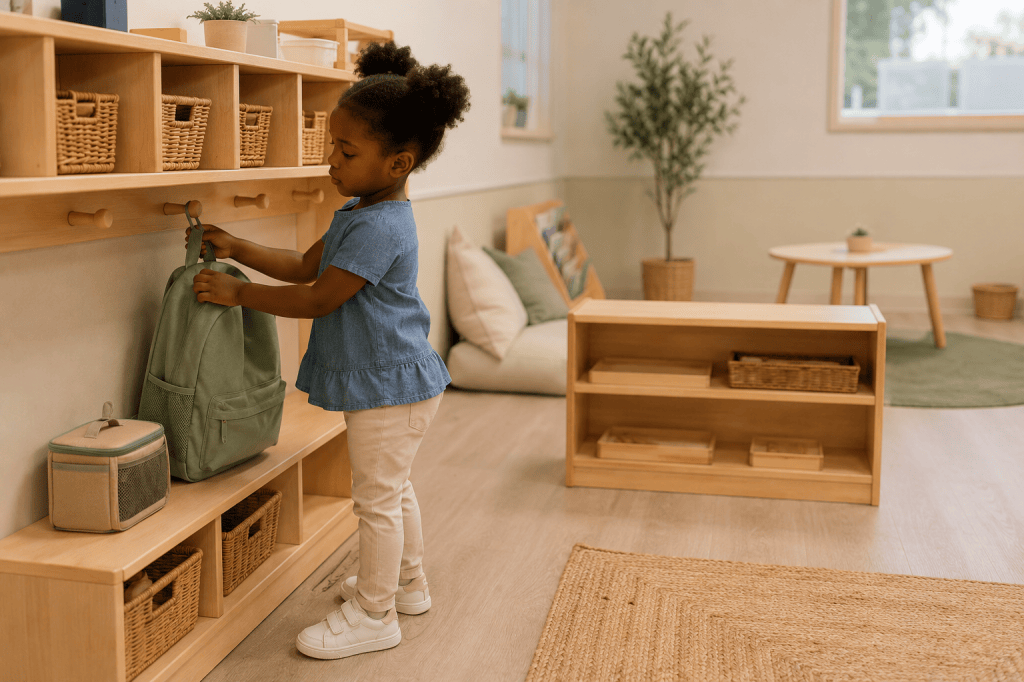
There is a moment that happens dozens of times in a preschool classroom.
A child holds out a backpack.
“Can you zip it?”
Another child can’t get a coat sleeve turned the right way.
“Help me.”
Someone finishes lunch and walks away, leaving everything on the table.
We zip the backpack. Fix the sleeve. Open the container. Carry the lunchbox. Put away the coat. Clean up the spill.
It is efficient.
It is helpful.
And sometimes, helping is exactly what a child needs.
But sometimes we are stepping in to complete a task that a child is ready to begin learning to do.
Building independence in preschool does not mean refusing to help children or expecting them to manage tasks beyond their developmental abilities. It means recognizing the everyday moments when children can participate, giving them enough time to try, and providing just enough support to help them succeed.
Those tiny opportunities add up.
A child who learns to hang up a backpack is not simply learning where backpacks go.
That child is learning:
I know what to do.
I can try.
I can solve a problem.
I can take care of something that belongs to me.
And I can ask for help when I need it.
That is what preschool independence is really about.
Independence Is Not the Same as Doing Everything Alone
When we talk about independence in early childhood, it is easy to swing too far in either direction.
On one end, adults do nearly everything for children because it is faster, cleaner, or easier.
On the other, independence can become an expectation that children should complete tasks alone before they are developmentally ready.
Neither approach is particularly helpful.
A better goal is increasing participation with appropriate support.
The National Association for the Education of Young Children (NAEYC) describes developmentally appropriate practice as strengths-based and responsive to each child’s development, individual characteristics, family, culture, language, abilities, and experiences.
NAEYC’s guidance also specifically addresses scaffolding: educators provide enough assistance for a child to accomplish something just beyond what they can currently do alone, and then gradually reduce that assistance as the child’s competence increases.
That support might mean giving a cue, offering a hint, modeling an action, adapting materials, or providing physical assistance when necessary.
In other words, the goal isn’t:
“Do it yourself.”
It is:
“Let’s figure out what part you can do.”
That distinction matters.
Why Preschool Is Such an Important Time for Independence
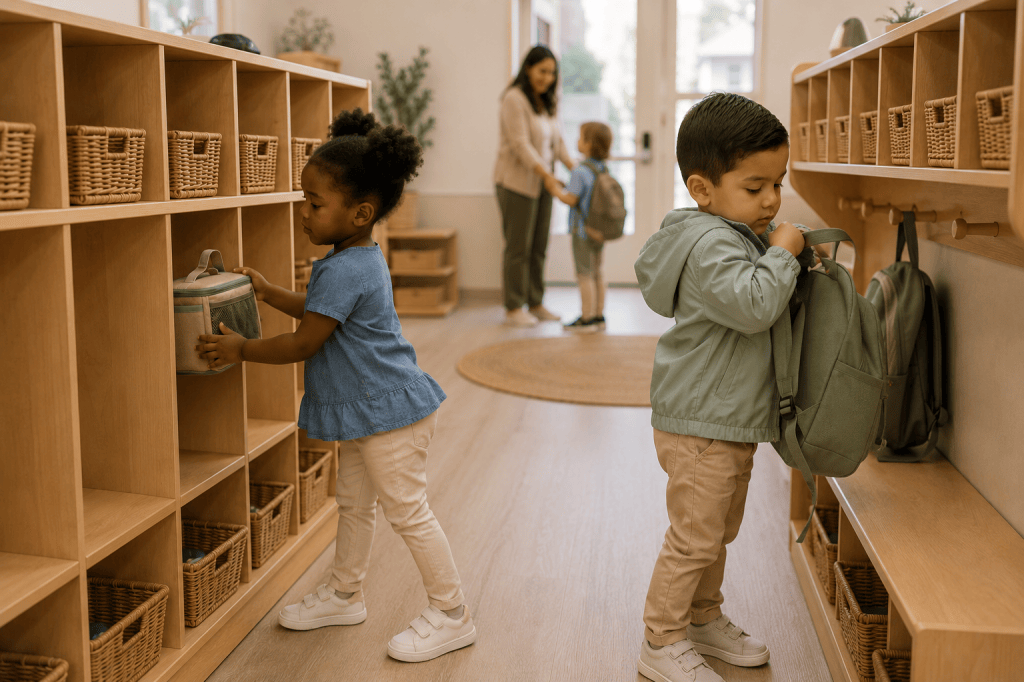
The preschool years are filled with emerging independence.
Children are learning to follow classroom routines, make choices, solve problems, manage belongings, care for materials, participate in self-care tasks, and increasingly regulate their own actions.
The Head Start Early Learning Outcomes Framework reflects this progression. Its preschool Approaches to Learning goals include children following classroom rules and routines with increasing independence. Examples include putting away a backpack when entering the classroom and completing familiar routines with fewer adult reminders over time.
This development isn’t instantaneous.
A younger preschooler may need an adult beside them saying:
“Your backpack goes on your hook.”
Later, the adult may simply point toward the cubbies.
Eventually, the child walks into the classroom, finds the correct space, takes off the backpack, and hangs it up without an adult saying anything.
That progression is independence developing in real time.
And it happens because the child has had repeated opportunities to practice.
These everyday experiences also contribute to the broader independence children will need as they move toward kindergarten. For more ideas, read How to Build Independence Before Kindergarten.
The Problem With Being Too Helpful
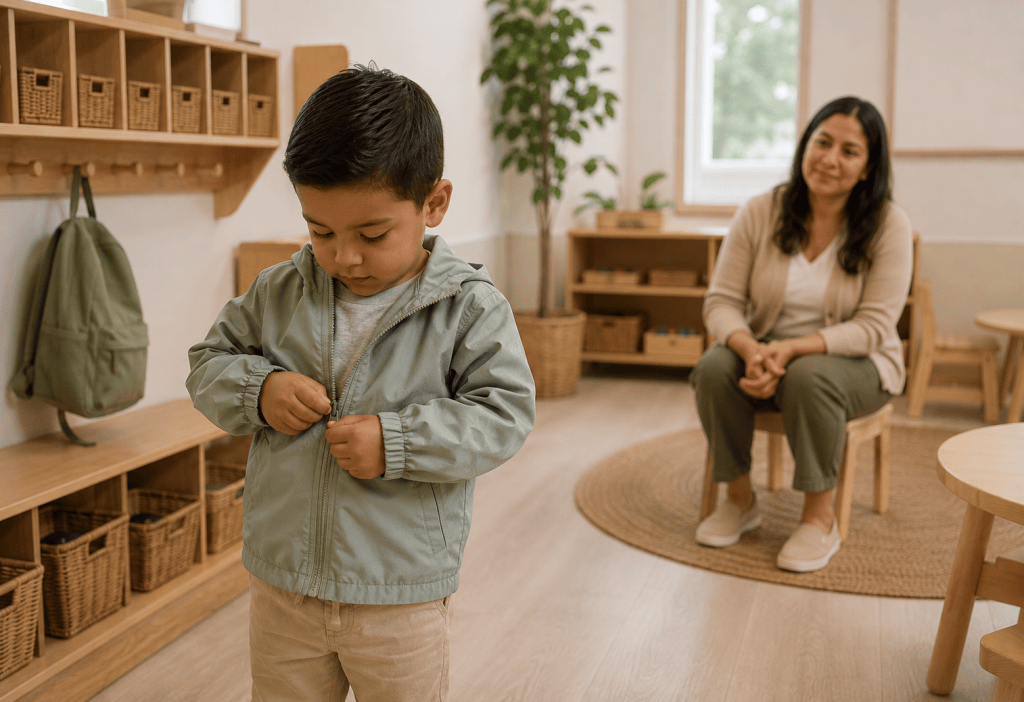
Most adults aren’t intentionally preventing children from becoming independent.
Usually, we’re trying to keep the day moving.
Imagine getting 16 preschoolers ready to go outside.
One can’t zip a coat.
Another has a mitten backward.
Someone can’t find a hat.
A boot is mysteriously missing.
Three children are already dressed and getting restless.
Of course the adult instinct is to start zipping, fixing, finding, and dressing.
Sometimes we have to.
But when that becomes the default every day, children lose practice opportunities.
The same thing happens during arrival.
Instead of waiting while a child works to get a backpack off, an adult removes it.
Instead of letting a child figure out where the lunchbox belongs, an adult takes it and puts it away.
Instead of allowing a child to wipe up a small spill, an adult grabs the towel.
Each individual interaction seems insignificant.
Collectively, however, those interactions communicate:
The adult does this part.
If we want children to become more independent, we have to intentionally create space for them to participate.
Try Waiting Before Helping
One of the simplest changes adults can make is also one of the hardest:
Wait.
Young children often need substantially more time to complete a task than adults do.
That doesn’t necessarily mean they can’t do it.
They may be:
- remembering what comes next
- coordinating both hands
- figuring out how an object works
- correcting an unsuccessful attempt
- processing a verbal direction
- deciding what strategy to try
- practicing a motor skill that is still developing
If we step in immediately, we never find out what the child could have done with another ten seconds.
So before completing a manageable task for a child, pause.
Watch.
You may discover that the child already has the solution.
Use the Least Amount of Help That Works
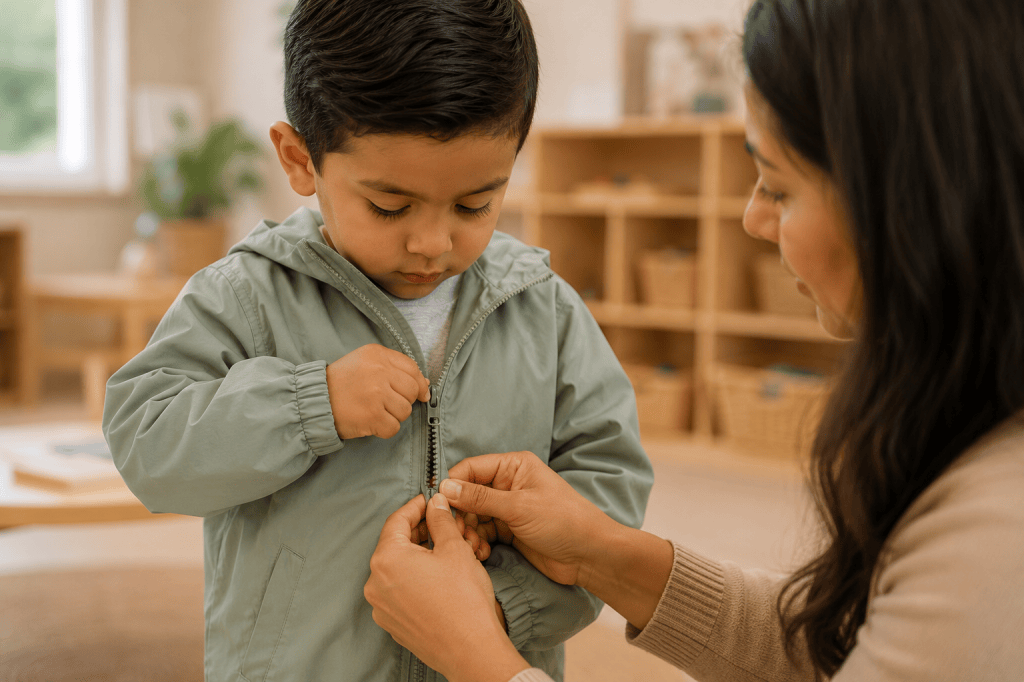
Independence doesn’t require adults to disappear.
It requires us to become more thoughtful about how much help we provide.
A useful progression is:
PAUSE
Give the child time to notice the problem and attempt the task.
POINT
Direct the child’s attention toward something that may help.
You might point toward the backpack hook rather than saying, “Hang up your backpack.”
PROMPT
Provide a short cue.
“Where does your lunchbox go?”
MODEL
If the child doesn’t know how to complete the task, show them.
“Watch how I hold the bottom of the zipper with this hand.”
HELP
Provide assistance with the part the child cannot yet manage.
Perhaps the adult starts the zipper and the child pulls it the rest of the way.
STEP BACK
As soon as the child can take over, let them.
This is scaffolding in everyday classroom practice: enough assistance to support success without automatically taking over the entire task.
Look → Try → Ask
There is another message we should intentionally teach children:
Asking for help is part of independence.
We don’t want children to interpret independence as:
I’m supposed to be able to do everything myself.
Instead, children can learn a simple process:
LOOK
What do I need to do?
Pause and look at the task, environment, or visual support.
TRY
I try what I can.
Attempt the manageable parts of the task.
ASK
I ask for help when I need it.
Recognize when assistance is necessary and appropriately seek it.
That last step is important.
A child who can say, “I tried, but I can’t get my zipper started. Can you help me?” is demonstrating independence too.
The goal is not the absence of adult support.
The goal is increasingly purposeful participation.
Visual Supports Can Replace Some of Our Verbal Reminders
Sometimes children aren’t dependent on adults for the task.
They’re dependent on adults for the reminder.
“Hang up your backpack.”
“Lunchbox in your cubby.”
“Don’t forget your sweater.”
“Check your cubby.”
“Get your things.”
“Zip your backpack.”
“Did you get your lunchbox?”
When adults provide the same verbal directions every day, children can unintentionally learn to wait for the direction instead of independently initiating the routine.
This is one reason visual supports can be so useful.
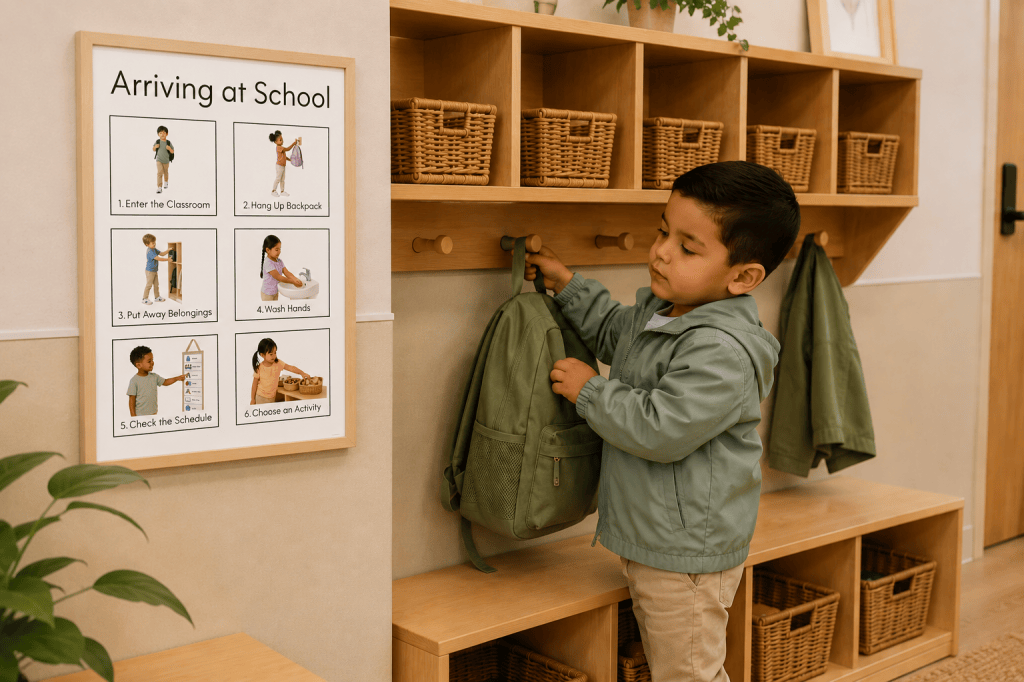
A photograph near the backpack hooks can remind a child what belongs there.
A visual near the cubbies can prompt children to check for their belongings.
A simple sequence can show children what happens next without requiring an adult to repeat every step.
Head Start guidance on schedules and routines notes that predictable routines can help young children know what is happening, what comes next, and how to complete an activity or task. As children become familiar with routines, they can demonstrate increasing independence.
The visual doesn’t replace teaching.
It becomes a cue after teaching.
Teach it.
Model it.
Practice it.
Then let the environment do some of the reminding.
Visual supports are especially powerful when they’re paired with predictable classroom routines. If reducing repeated directions is a challenge in your classroom, you may also find How to Teach Preschool Classroom Routines Without Constant Reminders helpful.
Everyday Self-Help Skills Preschoolers Can Practice
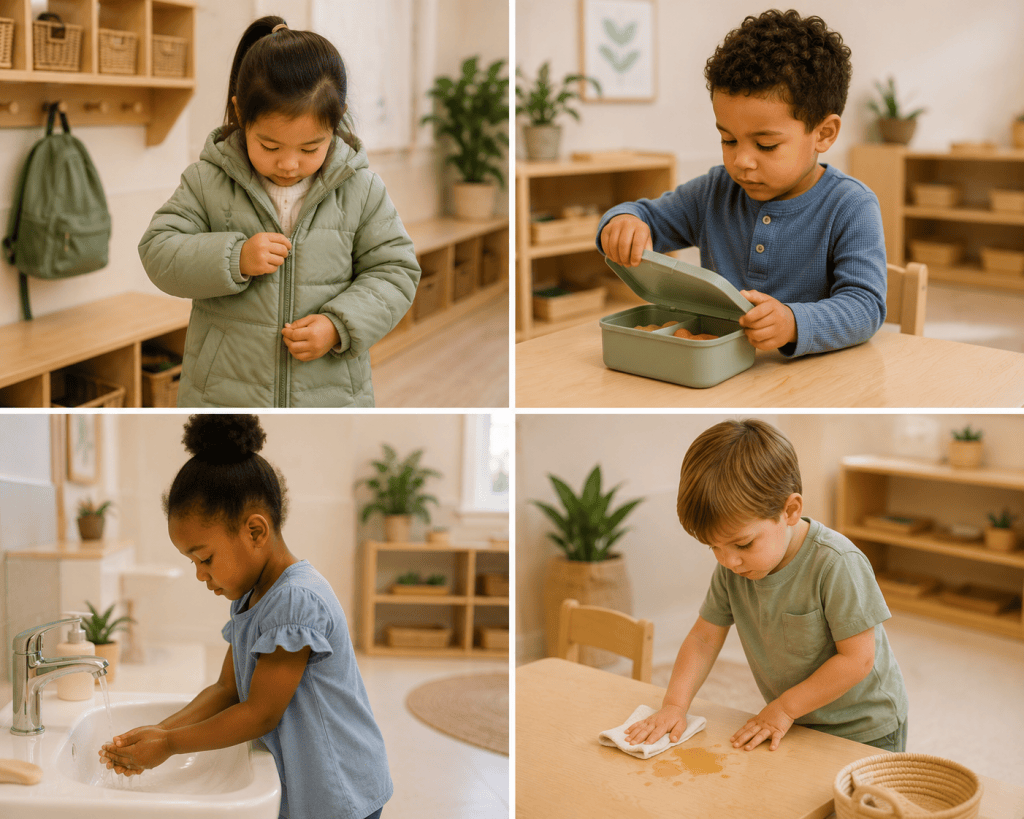
Independence doesn’t require a special “independence lesson.”
The preschool day is already full of opportunities.
Managing Belongings
Children can practice:
- recognizing their own belongings
- finding their cubby
- carrying manageable personal items
- taking off a backpack
- opening and closing a backpack
- hanging up a backpack
- putting away a lunchbox
- placing papers or folders inside a backpack
- checking their cubby
- packing belongings at the end of the day
Dressing
Depending on individual development, children can participate in:
- putting on a coat
- taking off a coat
- pulling sleeves through
- attempting zippers
- putting on hats
- putting on mittens
- putting on or removing boots
- placing outdoor clothing where it belongs
The child does not have to complete every step independently to participate meaningfully.
Mealtimes
Children may be able to:
- carry their lunchbox
- unpack food
- open manageable containers
- use utensils
- pour with appropriate materials and supervision
- use a napkin
- wipe a small spill
- throw away trash
- clear their eating space
- pack reusable items
Personal Care
Depending on the child and the setting, preschoolers can increasingly participate in:
- handwashing
- drying hands
- using a tissue
- disposing of tissues
- covering coughs and sneezes
- managing some clothing
- getting a drink
- completing familiar hygiene routines
Caring for the Classroom
Independence also extends beyond personal self-help.
Children can:
- return materials
- put books away
- wipe tables
- clean small spills
- push in chairs
- throw away trash
- help set up activities
- care for classroom materials
- participate in classroom jobs
NAEYC has also highlighted the developmental value of giving children genuine opportunities to contribute and help. Such participation can provide opportunities for problem-solving, initiative, perseverance, communication, collaboration, and asking for help.
Children are not simply recipients of care.
They can be contributing members of their classroom community.
Be Careful With “They Should Be Able to…”
There is an important caution whenever we discuss preschool independence.
A list of self-help skills should not become a universal developmental checklist.
Two four-year-olds may need very different levels of assistance with the same task.
Development can vary because of motor abilities, language development, experience, disability, temperament, sensory needs, cultural expectations, opportunities for previous practice, the complexity of the environment, and many other factors.
NAEYC’s Developmentally Appropriate Practice framework explicitly asks educators to consider both what is generally known about child development and the individual child and the child’s social and cultural context.
So rather than asking:
“Should a four-year-old be able to zip a coat?”
A more useful question is:
“How can this child meaningfully participate in getting their coat on today?”
Maybe they can put both arms into the sleeves while an adult starts the zipper.
Maybe they can pull up a zipper once an adult connects it.
Maybe they need more direct assistance.
The appropriate amount of support can change from child to child—and even from day to day for the same child.
Independence is a progression, not a pass/fail test.
Make the Environment Easier to Navigate
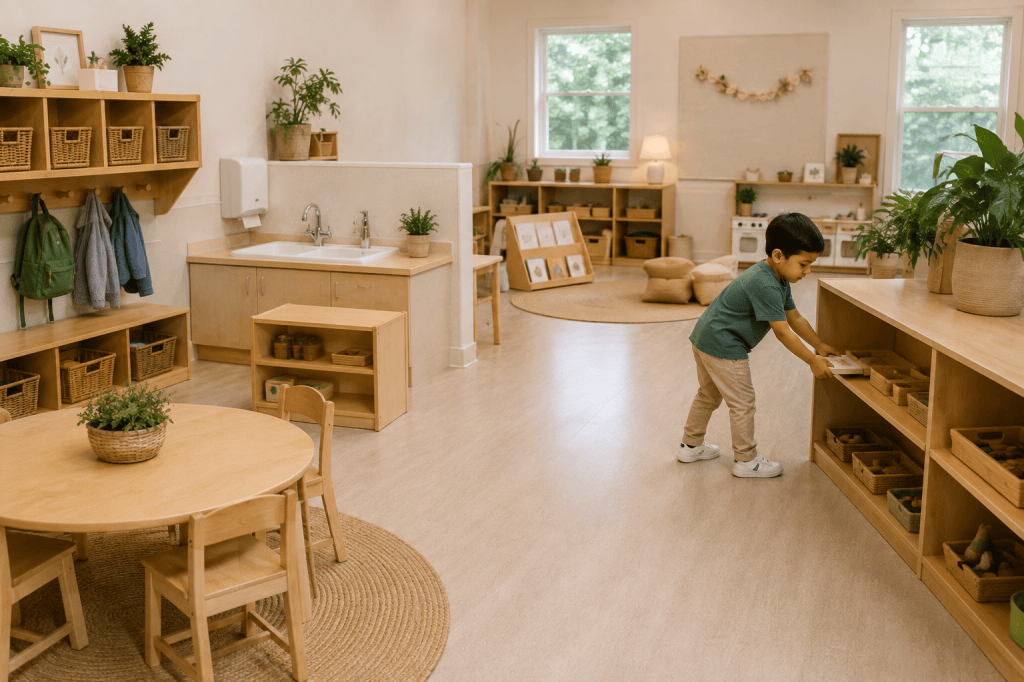
Sometimes what looks like a child’s lack of independence is actually an environment problem.
If children cannot reach the hooks, adults will hang the backpacks.
If every cubby looks identical and children cannot identify theirs, they will ask an adult.
If containers are too difficult to open, adults will open them.
If cleanup locations aren’t obvious, children will depend on directions.
If children don’t know what happens after handwashing, they’ll stand and wait.
Before assuming children “can’t do it,” look at the classroom.
Ask:
Can children reach what they need?
Can they tell where things belong?
Are materials manageable for small hands?
Are routines predictable?
Are visual cues available where the task actually occurs?
Have we explicitly taught the skill?
Do children have enough time to practice it?
A well-designed environment can quietly transfer responsibility from the adult back to the child.
Don’t Confuse Independence With Compliance
This distinction is especially important.
The purpose of building independence is not to create preschoolers who immediately follow every adult instruction without question.
Independence involves agency.
NAEYC’s guidance on developmentally appropriate teaching emphasizes opportunities for children to make meaningful choices, direct aspects of their learning, solve problems, and develop agency.
Sometimes an independent child is the child who says:
“I need help.”
“I don’t know where this goes.”
“This isn’t mine.”
“I can’t open this.”
“Can you show me?”
Those aren’t failures of independence.
They’re examples of children noticing a problem and communicating what they need.
What Growing Independence Actually Looks Like
Progress is often much smaller than adults expect.
It might look like:
Last month:
The teacher removed the backpack and hung it up.
Then:
The child removed the backpack while the teacher hung it.
Later:
The child removed the backpack and carried it to the cubby.
Then:
The teacher pointed toward the hook.
Eventually:
The child entered the classroom and completed the routine independently.
The adult support gradually decreased because the child’s competence increased.
That is exactly the progression we want.
Researchers at Harvard’s Center on the Developing Child describe scaffolding in a similar way: adults provide developmentally appropriate support while children practice emerging skills, then reduce that support as children become increasingly capable of performing the skills themselves.
We aren’t suddenly demanding independence.
We’re building it.
Independence is only one part of preparing children for the transition to kindergarten. Explore 5 Skills Kids Need Before Kindergarten (And How to Support Them) for a broader look at the skills that support school readiness.
A Question Worth Asking Yourself
The next time a preschooler hands you something they want opened, fixed, carried, zipped, cleaned, or put away, you don’t need to automatically refuse to help.
Instead, ask yourself:
What part of this could the child do?
Maybe the answer is all of it.
Maybe the answer is one tiny step.
Maybe today the answer is none of it—and the child genuinely needs you.
All three answers are okay.
The goal is simply to stop assuming that helping always means doing.
Sometimes the most helpful thing we can do is pause long enough for a child to discover:
I can do this part.
Making Independence Visible in the Classroom
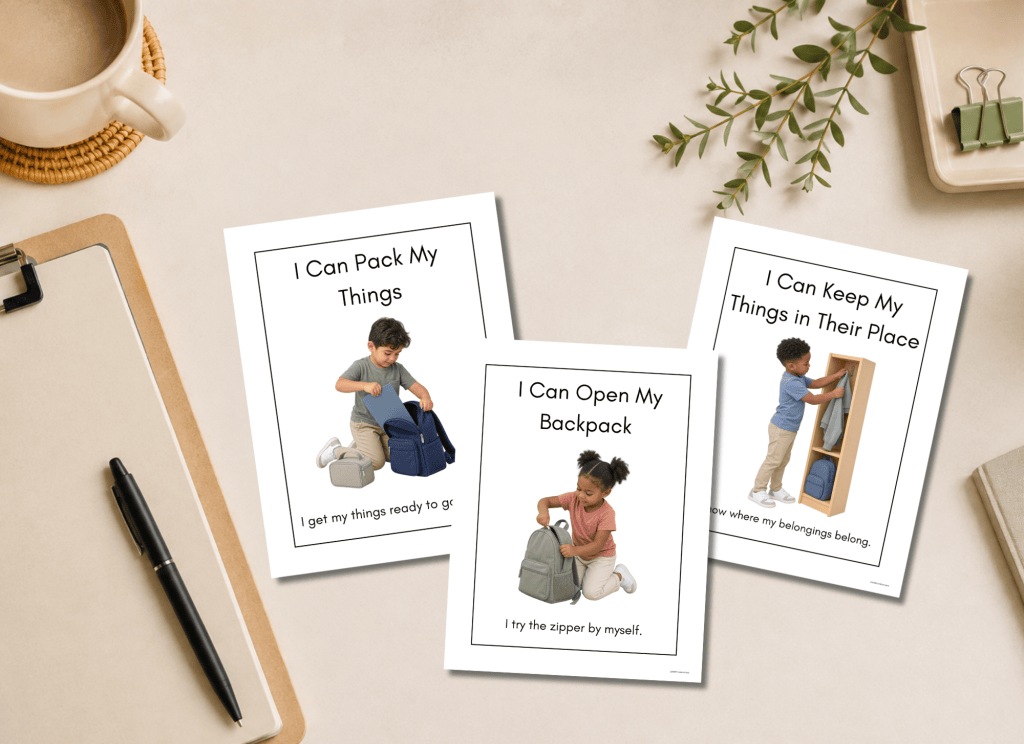
For everyday tasks that children encounter repeatedly, visual supports can make expectations easier to remember without requiring constant adult prompting.
That is why I created Taking Care of My Belongings, part of The Independence Collection from The Intentional Classroom Co.
The resource uses real photographs and positive “I Can” language to help children practice everyday skills such as finding their cubby, carrying their belongings, opening and hanging a backpack, putting away a lunchbox, checking their space, and packing their things to go home.
It also uses a simple Look → Try → Ask approach to reinforce an important message:
Children can try what they can—and asking for help is a skill too.
Small steps. Growing independence.
References & Further Reading
National Association for the Education of Young Children (NAEYC). Developmentally Appropriate Practice Position Statement. NAEYC.
NAEYC. Teaching to Enhance Each Child’s Development and Learning. Developmentally Appropriate Practice.
Office of Head Start. Approaches to Learning: Preschool. Head Start Early Learning Outcomes Framework.
Office of Head Start. The Importance of Schedules and Routines.
Center on the Developing Child at Harvard University. Building the Brain’s “Air Traffic Control” System: How Early Experiences Shape the Development of Executive Function.
 The Intentional Classroom Co
Leave a comment