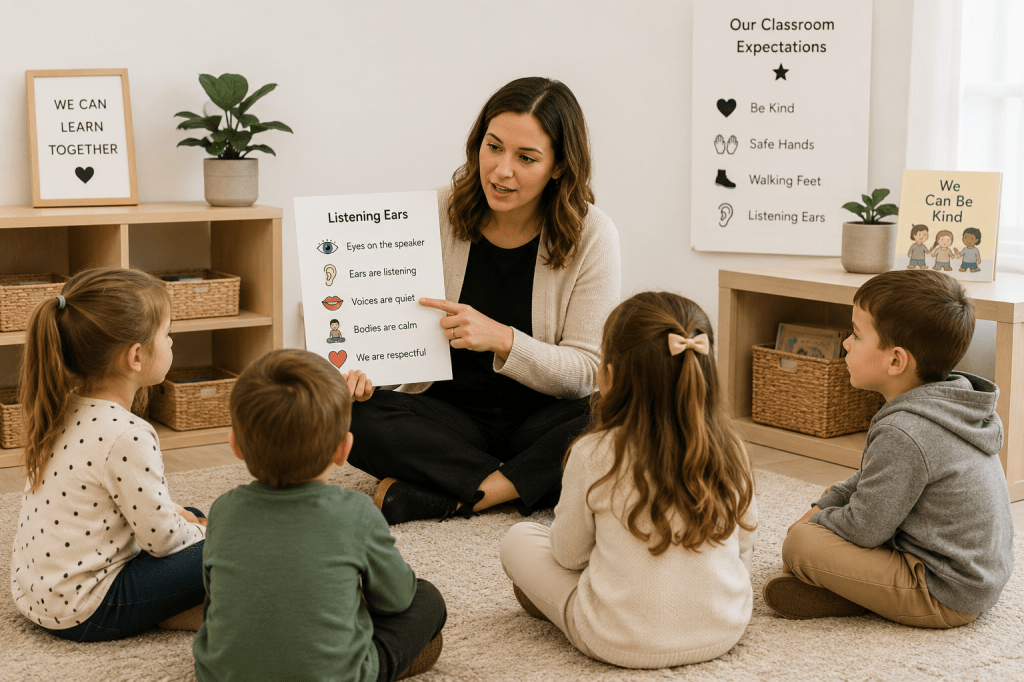
“Walking feet.”
“Listening ears.”
“Use safe hands.”
If you’ve said these phrases more times than you can count before lunch, you’re not alone.
Every preschool and kindergarten teacher has experienced the frustration of repeating the same reminders throughout the day. You remind one child to walk, another to keep their hands to themselves, and a third to listen during circle time. Five minutes later, you’re saying the exact same thing again.
It can feel like you’re constantly managing behavior instead of teaching.
But what if the problem isn’t that children aren’t listening?
What if they simply haven’t been taught the skill?
That shift in thinking can completely change the way we approach classroom behavior.
Behavior Is a Skill—Not Just an Expectation
When children enter our classrooms, we don’t expect them to know how to write their names, recognize every letter, or count to 20. We understand that these skills take time, practice, and intentional instruction.
Behavior is no different.
Children aren’t born knowing what “walking feet” means in a busy classroom. They don’t automatically understand what it looks like to be an active listener during a lesson or how to keep their hands safe when they’re excited, frustrated, or waiting for a turn.
These are learned skills.
Yet behavior is often treated differently than academics. Instead of teaching it, we tend to remind, redirect, or correct.
The truth is, reminders are most effective after a skill has been taught. If a child hasn’t learned the expectation yet, repeated reminders alone are unlikely to produce lasting change.
Why Repeating Expectations Isn’t the Same as Teaching Them
Think about teaching the alphabet.
You wouldn’t stand in front of the class and say, “Learn your letters,” then expect every child to master them through repetition alone.
You would:
- Introduce one letter at a time.
- Model how to recognize it.
- Practice it together.
- Read books that reinforce it.
- Provide opportunities to use it throughout the day.
Behavior deserves the same thoughtful instruction.
When we simply repeat, “Use listening ears,” we’re assuming children already know exactly what that means.
Many don’t.
They need us to teach it.
What Explicit Behavior Instruction Looks Like
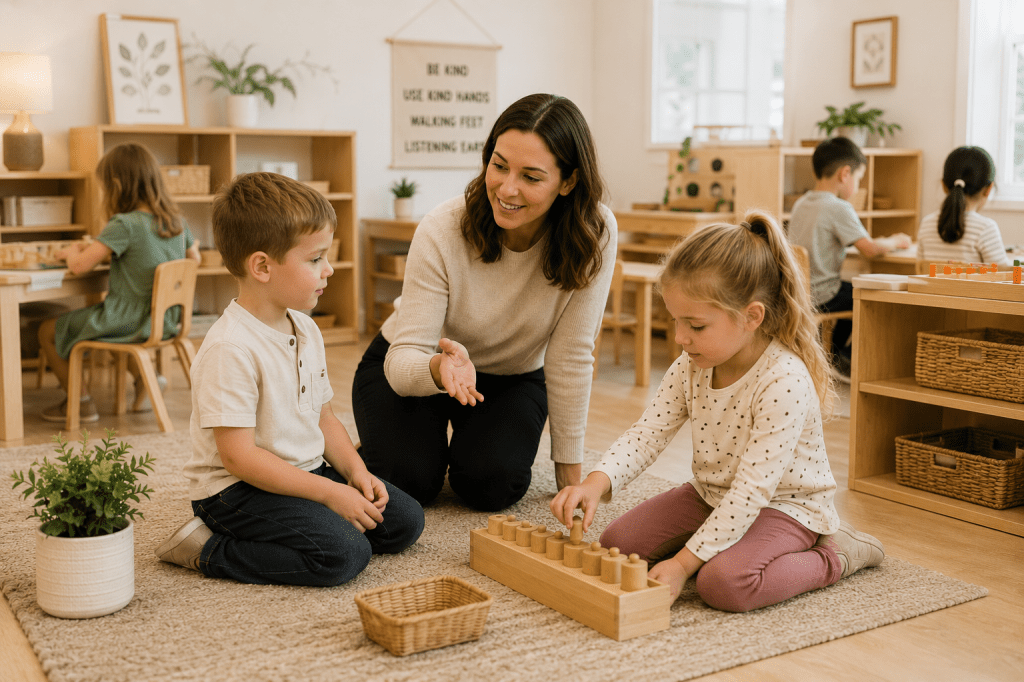
Teaching behavior doesn’t have to require complicated systems or elaborate reward charts. It simply means approaching behavior the same way we approach every other developmental skill.
A simple teaching sequence might look like this:
1. Introduce the Skill
Explain the expectation in child-friendly language.
Talk about why it matters.
Ask children what they already know.
2. Model the Behavior
Show children exactly what success looks like.
Demonstrate both examples and non-examples in a playful, supportive way.
Young children learn best when they can see the difference.
3. Practice Together
Give children opportunities to use the skill during games, transitions, and classroom routines.
Role-playing real classroom situations allows children to practice before they encounter those situations independently.
4. Reflect and Problem Solve
Talk about real situations.
Ask questions like:
- What happened?
- What could we do differently?
- Which choice helps keep everyone safe?
- How would that make our friends feel?
These conversations build understanding—not just compliance.
5. Reinforce Throughout the Day
Once children understand the skill, reminders become meaningful.
Instead of constantly correcting behavior, you’re simply reminding children of something they’ve already practiced.
That creates confidence instead of frustration.
Three Foundational Skills Every Preschool Classroom Should Teach
Every classroom has unique expectations, but three behavior skills create the foundation for almost everything else.
Walking Feet
Walking safely is about much more than preventing children from running.
It helps children learn body awareness, move safely through shared spaces, transition calmly between activities, and contribute to a classroom where everyone feels safe.
Rather than reminding children to “walk” throughout the day, teach what walking feet look like, when they’re expected, and why they matter.
Safe Hands
Young children are still learning self-control, emotional regulation, and appropriate ways to interact with others.
Teaching safe hands helps children understand how to:
- Respect personal space
- Care for classroom materials
- Solve conflicts without hitting or grabbing
- Show kindness through gentle touches
When children know what to do instead of simply hearing what not to do, they’re more likely to make positive choices.
Listening Ears
Listening is much more than hearing words.
It includes:
- Looking at the speaker
- Quieting our bodies when appropriate
- Paying attention
- Following directions
- Participating in conversations
These skills support not only classroom behavior but also language development, friendships, and academic learning.
The Goal Isn’t Perfect Behavior
One of the biggest misconceptions in early childhood education is that good teaching results in children who never need reminders.
That’s not realistic.
Young children are still developing self-control, attention, and emotional regulation. They will forget. They will make mistakes. They will need support.
Our goal isn’t perfection.
Our goal is progress.
Every time we intentionally teach, model, practice, and reinforce a behavior skill, we’re helping children build habits that will serve them far beyond preschool or kindergarten.
Teaching Behavior Builds Stronger Classrooms

When behavior is taught as a skill instead of managed as a problem, classrooms begin to feel different.
Children understand what’s expected because they’ve had opportunities to learn and practice those expectations.
Teachers spend less time repeating directions and more time engaging with children.
Transitions become smoother.
Conflicts become teachable moments.
Most importantly, children experience success. They gain confidence because they know what to do, not just what to avoid.
Teaching behavior isn’t about controlling children. It’s about giving them the skills they need to thrive in a classroom community.
Final Thoughts
Behavior is one of the most important things we teach—but it’s often the one we spend the least time intentionally planning for.
When we approach behavior with the same care we give literacy, math, and social-emotional learning, we create classrooms where children can succeed because they understand what success looks like.
The next time you find yourself saying, “Walking feet,” “Use safe hands,” or “Listening ears,” pause for a moment and ask yourself:
Have I reminded this skill… or have I taught it?
That simple question can transform the way we support young learners.
Ready to Teach Behavior with Intention?
If you’re looking for ready-to-use lessons that follow this instructional approach, explore the Positive Behavior Skills Collection from The Intentional Classroom. Each unit is designed to help teachers explicitly teach foundational classroom behaviors through engaging lessons, role-play, real-life photo scenarios, visual supports, family connection activities, and positive reinforcement.
Whether you’re introducing classroom expectations at the beginning of the year or reinforcing them throughout the school year, these resources help turn everyday reminders into meaningful learning opportunities.
 The Intentional Classroom Co
Leave a comment