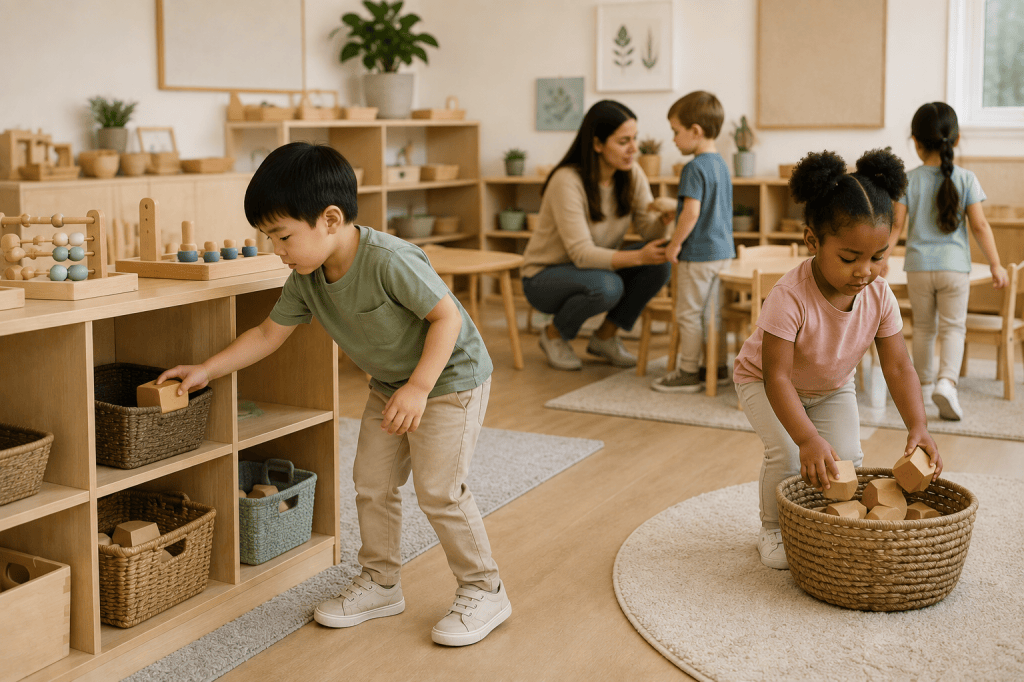
If you teach preschool, you’ve probably had days when it feels like you repeat the same directions from morning until afternoon.
“Hang up your backpack.”
“Wash your hands.”
“Find your spot.”
“Clean up your materials.”
“What’s next?”
And then, five minutes later, you say it all again.
It is easy to assume that children aren’t listening or that they simply need more reminders. But often, the problem isn’t that preschoolers need to hear the direction one more time.
They need the routine to be taught.
Classroom routines are skills, just like sharing, writing a name, putting on a coat, or using scissors. Young children don’t automatically know all of the little steps involved in moving successfully through a preschool day.
When we explicitly teach those steps—and give children something visual to reference—we can gradually shift some of the responsibility from the teacher to the child.
The goal isn’t a classroom where children never need help.
The goal is a classroom where the teacher doesn’t have to be the only source of information about what happens next.
Why Preschoolers Need More Than Verbal Reminders
Think about a routine that seems simple to an adult, such as getting ready to go outside.
To us, “Get ready for outside” sounds like one direction.
To a preschooler, it may actually mean:
- Finish what you’re doing.
- Clean up your materials.
- Go to the bathroom.
- Find your cubby.
- Get your coat.
- Put on your coat.
- Find your outdoor gear.
- Get in line.
- Wait safely.
That’s a lot to remember.
The same thing happens throughout the preschool day.
“Get ready for lunch.”
“Clean up.”
“Get ready for rest.”
“Put your things away.”
Each short teacher direction may actually represent an entire sequence of behaviors.
When children don’t complete the sequence independently, our natural response is often to add more words:
“First put the blocks away. No, the blocks go in that basket. Now go wash your hands. Remember to get a paper towel. Then go find your seat…”
Before long, the teacher has become a walking audio version of the classroom schedule.
Instead of adding more verbal directions, it can be much more effective to make the routine itself clearer.
Teach Classroom Routines Like You Teach Everything Else
We wouldn’t place a pair of scissors in front of a preschooler and assume they know how to use them safely.
We teach the skill.
We model it.
We practice it.
We give feedback.
And then we provide opportunities to try again.
Preschool classroom procedures deserve the same intentional teaching.
Rather than saying:
“Okay, everyone, clean up!”
break cleanup into observable steps.
For example:
Stop playing → Find something to clean → Put materials away → Check your area → Go to the next space.
Show children what each step actually looks like.
Practice when you aren’t in a hurry.
Talk about what to do when something unexpected happens.
Then reinforce the same sequence during the actual classroom routine.
This turns an abstract instruction like “clean up” into a skill children can learn.
Why Visual Routines Work So Well in Preschool
Verbal directions disappear as soon as we say them.
A visual stays.
That difference matters for young children.
When a preschooler forgets what comes next, a visual routine gives the child another source of information besides the teacher.
Instead of immediately answering:
“What do I do next?”
you can begin saying:
“Let’s check the steps.”
Over time, children can learn to check those steps themselves.
Visual supports can also make expectations more concrete. Instead of expecting children to remember several verbal directions at once, they can see the sequence in front of them.
This doesn’t mean visuals instantly create independence.
They still need to be taught.
The power comes from combining:
explicit teaching + modeling + practice + consistent visual support
rather than simply hanging a picture on the wall and expecting children to use it.
8 Preschool Classroom Routines to Teach First
You don’t need to teach every classroom procedure on the first day.
Start with the routines children encounter most frequently and the ones that have the greatest impact on how smoothly the day flows.
1. Arrival
Arrival sets the tone for the entire day.
Instead of simply telling children to “get ready for the day,” teach exactly what happens after they enter the classroom.
Depending on your program, that might include entering the classroom, putting away belongings, washing hands, checking the visual schedule, and choosing an activity.
2. Putting Away Belongings
“Put your stuff away” actually requires several decisions.
Where does the backpack go?
What happens to the lunchbox?
Where does a coat belong?
What should children do when they’re finished?
Teaching these small steps can make arrival much more independent.
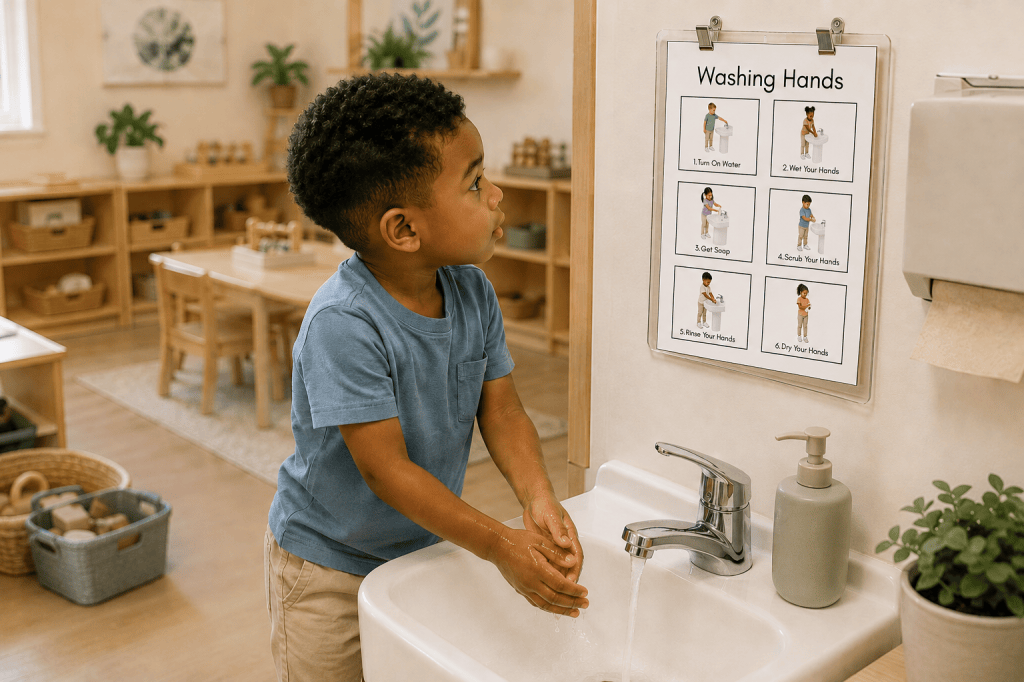
3. Handwashing
Handwashing is an especially good routine for visual support because it contains a predictable sequence.
Children can learn where to stand, how to use soap and water, how to dry their hands, and what to do when they’re finished.
Rather than repeating each individual step, the teacher can redirect children back to the visual sequence.
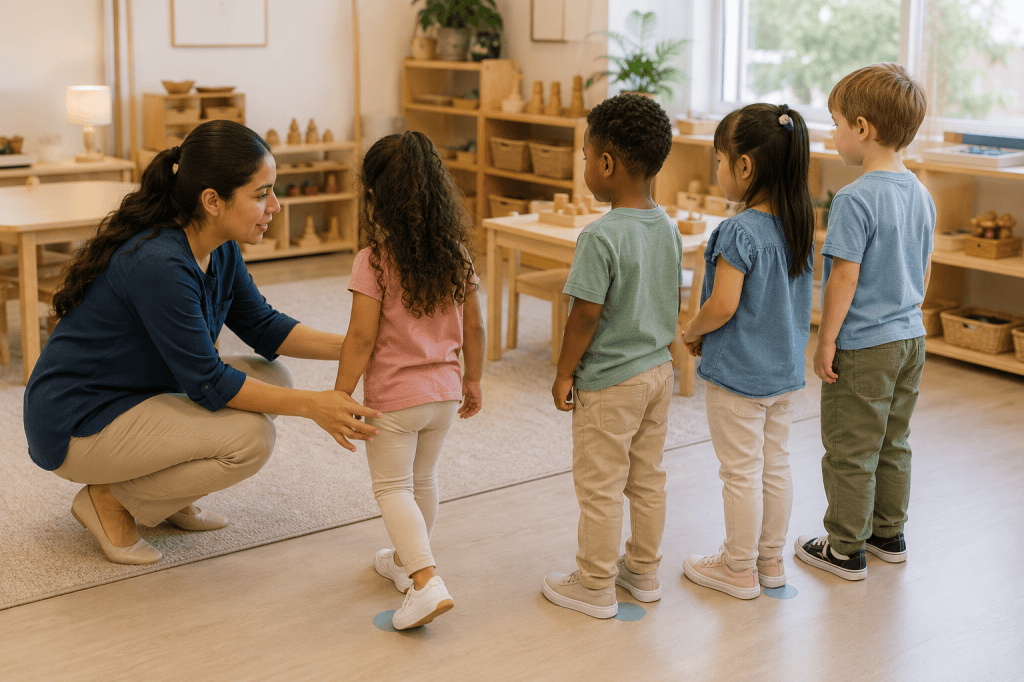
4. Lining Up
We sometimes tell children to “line up” without realizing how much classroom knowledge that phrase assumes.
Teach children how to walk to the line, find a space, keep their bodies in their own space, and wait safely.
Showing children what successful lining up actually looks like is much clearer than repeatedly saying, “Stay in line!”
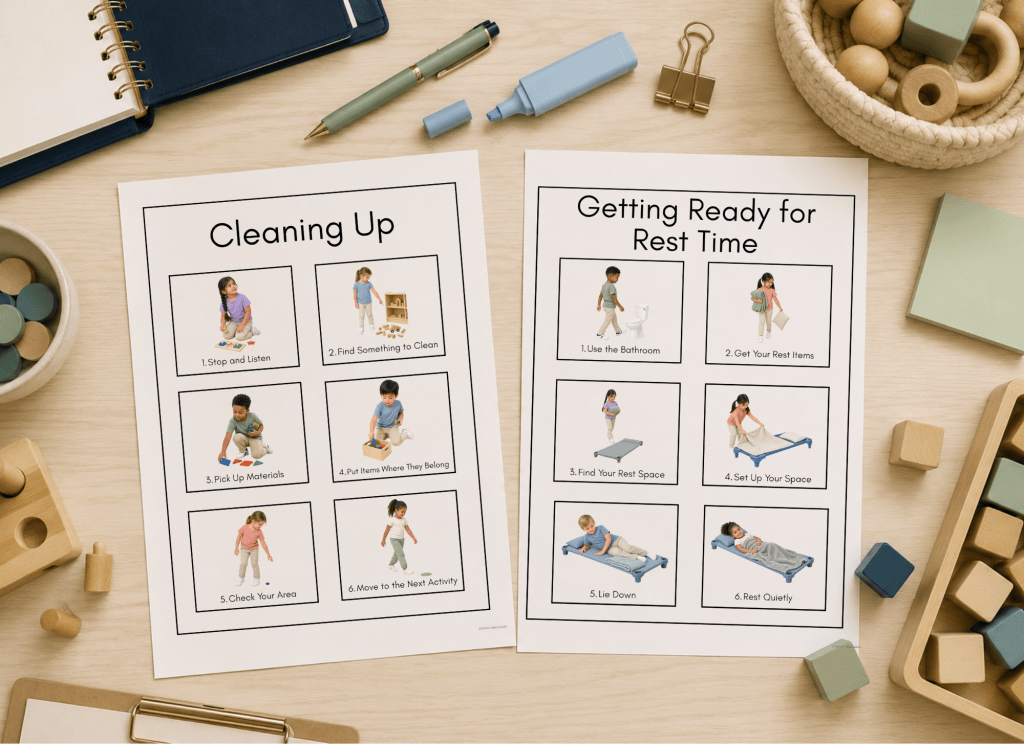
5. Cleanup
Cleanup can quickly become one of the loudest and most teacher-directed parts of the preschool day.
Break it down.
Teach children how to recognize that cleanup has started, choose something to put away, return materials to their correct locations, check the area, and transition to what happens next.
The more predictable the sequence becomes, the less the teacher needs to direct every individual child.
6. Mealtime
Snack and lunch include many routines beyond simply eating.
Children may need to wash their hands, find their seat, get their food, keep food at their own place, throw items away, clean their eating space, and wait for the next transition.
Explicitly teaching the sequence can make mealtimes feel significantly calmer.
7. Rest Time
Rest time is another transition with multiple steps.
Children may need to use the bathroom, find their rest space, set up their belongings, settle their bodies, and understand what is expected while other children are resting.
Visual steps can make the transition predictable even for children who do not fall asleep.
8. Dismissal
By dismissal, everyone is tired—including the adults.
A clear dismissal routine helps children understand where to go, what belongings they need, where to wait, and what happens when their grown-up arrives.
Predictability is especially valuable during a part of the day that can otherwise become busy very quickly.
Having predictability also reduces stress. Knowing what comes next is reassuring and can lower anxiety. Less stress=positive behaviors.
A Simple Way to Teach Any Preschool Routine
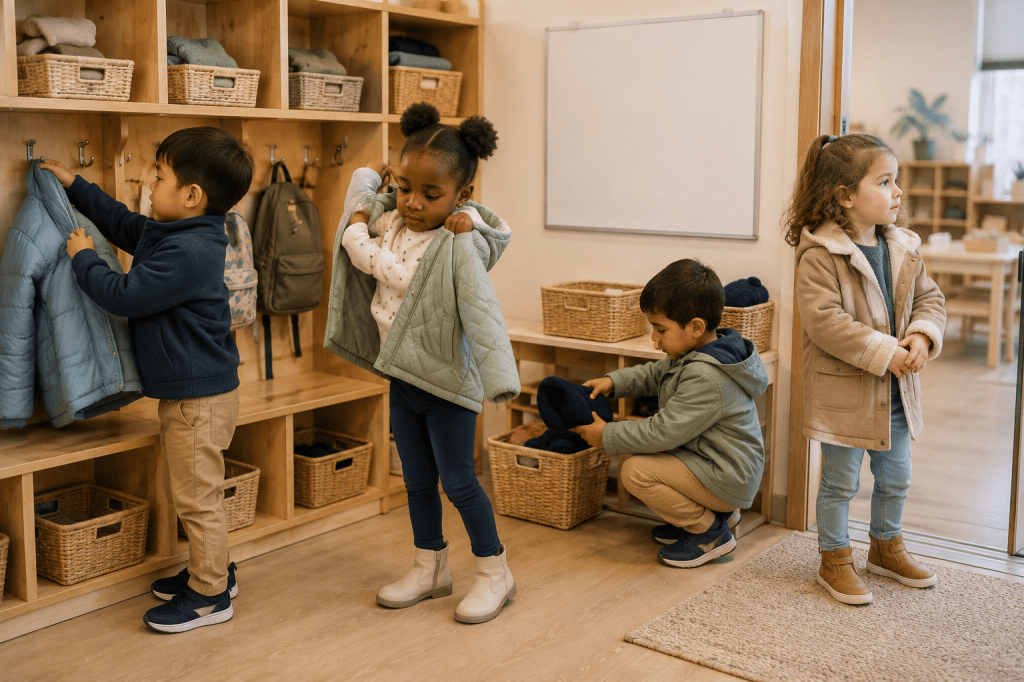
You can use the same basic process for almost any classroom procedure.
Step 1: Name the Routine
Be specific.
Instead of teaching children to “be ready,” name what they’re learning:
“We’re going to practice how we get ready to go outside.”
This helps children understand that the routine itself is something they are learning.
Step 2: Break It Into Small Steps
Ask yourself:
What does a child actually have to do from beginning to end?
Write down every step.
Then simplify.
Preschoolers need enough information to succeed without turning the routine into a 15-step checklist.
Step 3: Show What Each Step Looks Like
Model the routine yourself or demonstrate it with children.
Don’t just tell children:
“Wait safely.”
Show them what waiting safely looks like.
Where is your body?
Where are your hands?
What can you do while you wait?
Concrete examples are much easier for young children to understand than abstract expectations.
Step 4: Add a Visual Reference
Once you’ve modeled the sequence, connect it to a visual.
Point to each step as you practice.
Use the same language each time.
The visual should become a reference tool rather than classroom decoration.
Step 5: Practice Before You Need It
This is one of the most important pieces.
The hardest time to teach a routine is when 18 preschoolers are already waiting for lunch and everyone is hungry.
Practice important routines when the pressure is low.
Try lining up when you aren’t actually going anywhere.
Practice cleanup during a small-group activity.
Walk through the arrival sequence later in the morning.
Rehearsal gives children an opportunity to learn without the urgency of the actual transition.
Step 6: Redirect Children Back to the Routine
This is where independence begins.
When a child asks:
“What do I do next?”
instead of immediately giving the answer, try:
“Check the steps. What comes next?”
You’re still supporting the child.
But you’re also teaching them where to find the information.
From Constant Reminders to Growing Independence
The goal of visual classroom routines isn’t to eliminate teacher interaction.
Young children will always need guidance, encouragement, redirection, and connection.
What we can reduce is the number of times adults have to provide the same procedural information.
There is an important difference between:
“You forgot. Go wash your hands.”
and:
“Let’s check what comes next.”
The first keeps the information with the adult.
The second gradually teaches the child how to find it.
That’s a small shift, but over the course of a preschool day it can make a meaningful difference.
Children begin learning:
I know where to look.
I know what happens next.
I can do some of this myself.
And teachers can spend less time narrating every transition and more time actually teaching.
As children become familiar with classroom routines, we also want them to begin taking greater responsibility for the everyday tasks they can manage. Learn more about how to build independence in preschool without doing everything for children.
When a Routine Isn’t Working, Look at the Steps
If you find yourself giving the same reminder over and over, pause before assuming the children simply aren’t following directions.
Ask:
Have I actually taught this routine?
Are the steps clear?
Is there a step I’m assuming children already understand?
Have children seen what success looks like?
Do they have a visual reference?
Have we practiced when we’re not rushed?
Sometimes the classroom management problem isn’t the child’s behavior.
Sometimes the procedure simply needs more teaching.
18 Step-by-Step Visual Routines for Preschool
I created the 18 Step-by-Step Visual Routines to make this process easier for preschool and Pre-K teachers.
Instead of starting from scratch every time you realize a classroom routine needs more explicit teaching, the resource breaks common parts of the preschool day into clear, child-friendly visual steps.
The routines cover everyday classroom moments including:
- Arrival
- Putting away belongings
- Bathroom and handwashing routines
- Lining up
- Hallway transitions
- Staying with the group
- Cleanup
- Snack and lunch
- Outdoor preparation
- Returning indoors
- Rest time
- Dismissal
- And additional everyday classroom procedures
Use the visuals to introduce a routine, model individual steps, practice together, reinforce expectations during transitions, or give children something to reference when they forget what comes next.
You Don’t Need to Repeat It Forever
Preschoolers aren’t going to master every classroom routine after one lesson.
There will still be reminders.
There will still be messy transitions.
And there will absolutely still be days when everyone seems to forget everything you’ve ever taught them.
But the goal isn’t perfection.
It’s to gradually move from:
Teacher tells → Child follows
toward:
Teacher teaches → Child checks → Child remembers → Child does
That’s what well-taught classroom routines can provide.
So the next time you hear yourself giving the same direction for what feels like the twentieth time, consider whether another reminder is really what the child needs.
Maybe they need something they can see, follow, and eventually do without you.
 The Intentional Classroom Co
Leave a comment