If you work with preschoolers, you probably say some version of these phrases more times than you can count:
“Don’t grab.”
“Stop pushing.”
“No hitting.”
“You need to wait.”
“Use your words.”
“Make a good choice.”
There are times when children absolutely need us to stop an unsafe behavior immediately. But once everyone is safe, there is another question worth asking:
Does the child actually know what to do instead?
Preschoolers are still learning how to wait, handle frustration, enter play, solve problems with friends, manage disappointment, ask for space, and respond when someone else has something they want.
Those skills don’t automatically appear because we tell a child what not to do.
They have to be taught.
And that small shift—from repeatedly correcting unwanted behavior to intentionally teaching the behavior we want to see—can make a big difference in a preschool classroom.
Why Saying “No” Isn’t Always Enough
Imagine two children are playing and one reaches over and grabs the truck the other child is using.
We intervene:
“No grabbing. Give it back.”
The child returns the truck.
The immediate problem is solved.
But what happens the next time that child wants something another child has?
If we haven’t taught an alternative, grabbing may still be the only strategy the child knows.
The same thing happens when we say:
“Don’t push.”
“Stop yelling.”
“Don’t take that.”
“You have to wait.”
Those directions tell children which behavior needs to stop. Sometimes that is necessary, especially when safety is involved.
But stopping a behavior and teaching a replacement behavior are two different things.
Instead of only asking:
How do I get this behavior to stop?
It can help to also ask:
What skill does this child need in order to handle this situation differently next time?
That question changes the way we respond.
Behavior Is Often a Skill-Building Opportunity
Preschool classrooms are full of complicated social situations.
Someone has the toy I want.
Someone is standing too close to me.
I want to go first.
A friend tells me no.
I want to join a game that has already started.
My block tower falls.
I have to wait.
Someone doesn’t want to play the way I want to play.
These situations may seem small to adults, but they require a surprising number of skills.
A child may need to recognize a problem, manage an emotional response, communicate what they need, consider another person’s perspective, think of possible solutions, choose an appropriate response, and sometimes accept an outcome they don’t particularly like.
That’s a lot for a four-year-old.
When we view these moments as opportunities to teach skills, rather than simply problems we need to make disappear, our response can become much more intentional.
What Should We Teach Instead?
There isn’t one script that works for every preschool behavior problem.
There is, however, a simple process we can return to again and again:
1. Help the child understand what happened.
2. Make the expected behavior clear.
3. Give the child concrete choices.
4. Help the child find a solution.
5. Practice the skill when everyone is calm.
Over time, the goal is for the adult to do less of the problem solving while the child gradually does more.
Let’s look at what that can actually look like.
When a Preschooler Grabs a Toy
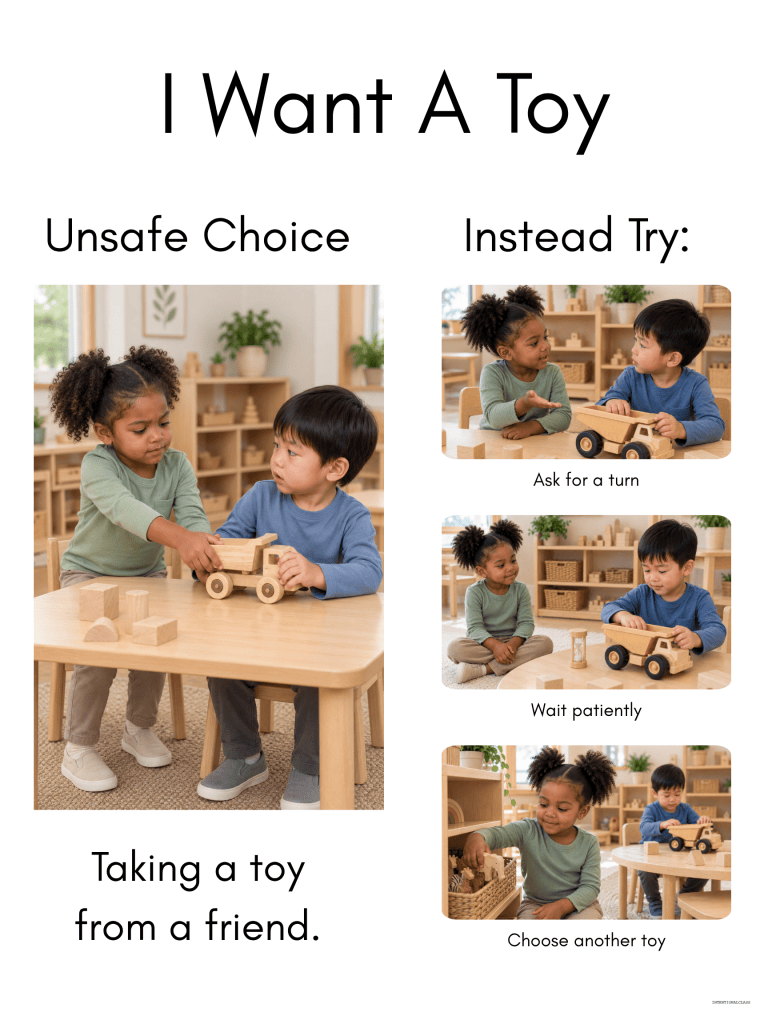
Grabbing is one of the most common preschool conflicts.
We could simply say:
“No grabbing.”
But the child still needs an answer to the original problem:
I want that toy. What can I do?
Possible replacement behaviors might include:
- Ask for a turn.
- Wait until the other child is finished.
- Use another similar toy.
- Choose something else while waiting.
- Ask a teacher for help if the children can’t solve the problem.
Instead of expecting a young child to generate all of those possibilities in the middle of a frustrating moment, we can teach and practice them ahead of time.
Then when the real situation happens, our prompt can become much simpler:
“You want the truck. What could you do?”
Now we’re helping the child retrieve a skill rather than invent one under stress.
When a Preschooler Hits or Pushes
Safety comes first.
If a child is hitting or pushing, we need to stop the unsafe behavior.
But after that, “no hitting” isn’t the end of the teaching.
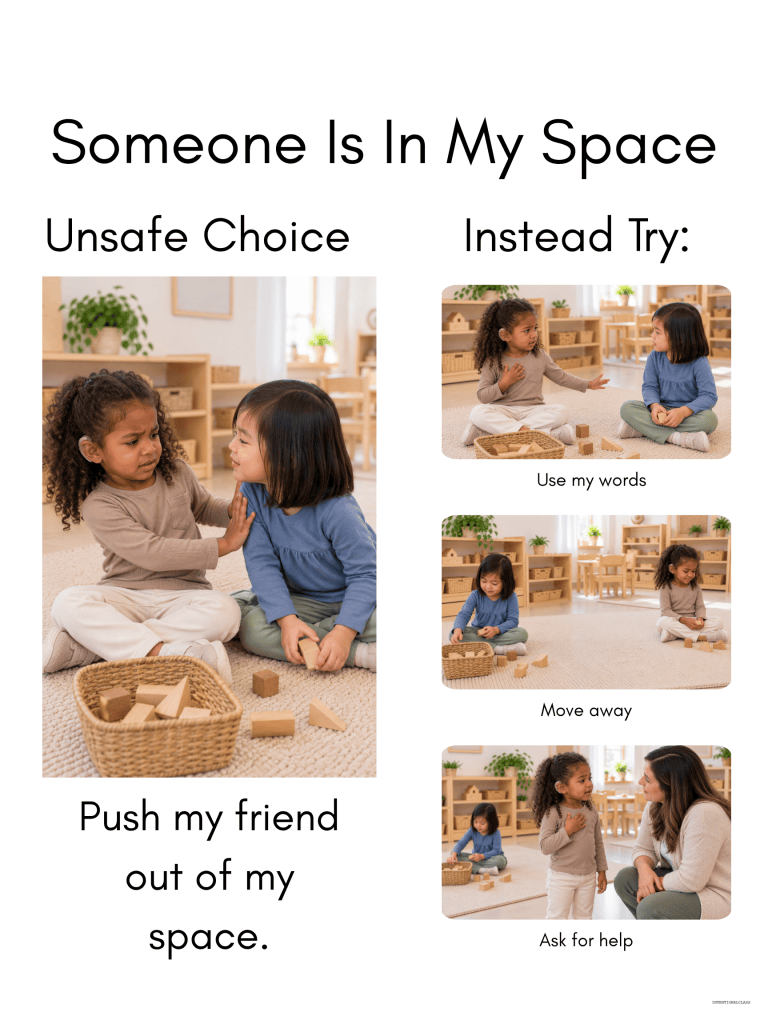
We can help the child learn what safe hands look like and what to do when they’re angry, frustrated, crowded, or trying to get something they want.
Depending on the situation, replacement skills might include:
- Keep hands close to your own body.
- Say, “I need space.”
- Move away.
- Say, “Stop, please.”
- Ask for help.
- Take space to calm down.
- Tell someone what happened.
The replacement skill should connect to the reason the behavior happened.
A child who pushed because another child entered their personal space may need a different strategy than a child who pushed because they wanted to be first.
That’s why teaching only “Don’t push” has limitations.
We want children to build a collection of strategies they can choose from.
When a Preschooler Has to Wait
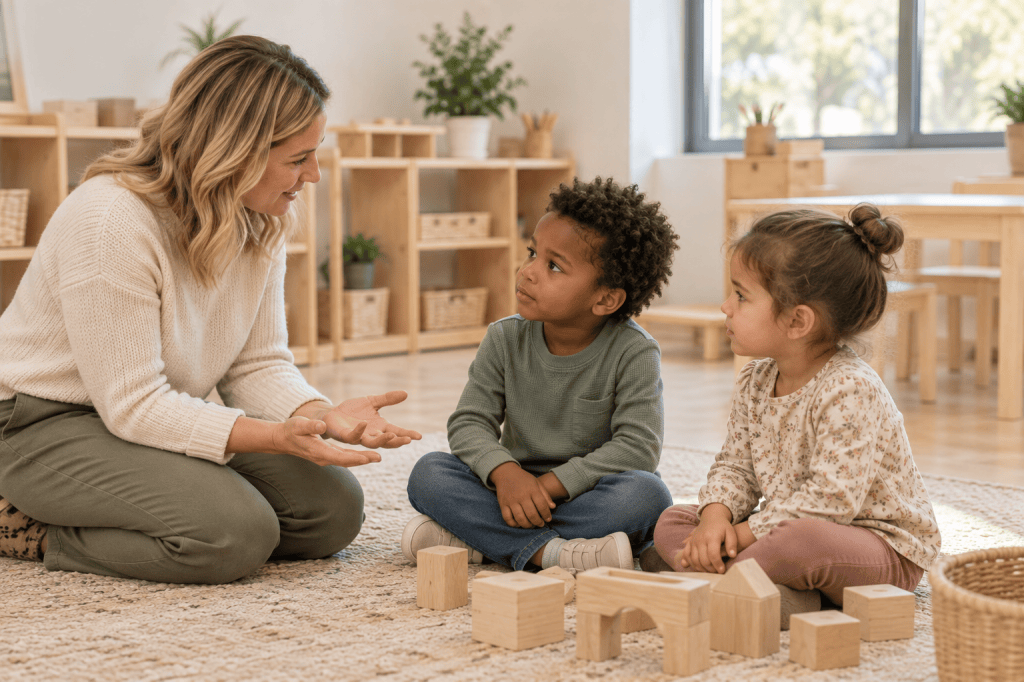
Waiting is hard when you’re four.
And “You need to wait” doesn’t actually tell a child how to wait.
Waiting is a skill.
We can teach children that while they wait, they might:
- Keep their hands to themselves.
- Watch while another child takes a turn.
- Choose something else to do.
- Use a timer or another visual when appropriate.
- Ask when their turn will be.
- Take a breath when waiting feels frustrating.
It also helps to keep expectations developmentally appropriate.
Young children generally need much more support with waiting than older children do. When possible, classroom routines and environments should reduce unnecessarily long waits rather than treating the ability to stand quietly for extended periods as a behavior goal.
The goal isn’t perfect patience.
The goal is gradually developing the ability to handle short, reasonable periods of waiting.
When a Friend Says “No”
This can be surprisingly difficult.
A child asks for a toy.
“No.”
A child asks someone to play.
“No.”
A child wants to sit somewhere.
“No, I’m sitting here.”
Adults know that we don’t always get the answer we want. Preschoolers are just beginning to learn this.
Instead of only responding to the behavior that follows the “no,” we can teach children what they can do when another child sets a limit.
They might:
- Choose something else.
- Ask another friend.
- Wait and try again later.
- Find another place to play.
- Ask a teacher for help when they genuinely need it.
We can also teach an important distinction: problem solving doesn’t always mean getting what we originally wanted.
Sometimes the solution is finding another acceptable option.
That’s an important social skill that takes time to develop.
When a Preschooler Wants to Join Play
“Go play with them!”
It sounds simple.
But joining an existing group requires a lot of social awareness.
A child needs to approach the group, understand what the other children are doing, communicate an interest in joining, and respond appropriately if the answer isn’t immediately yes.
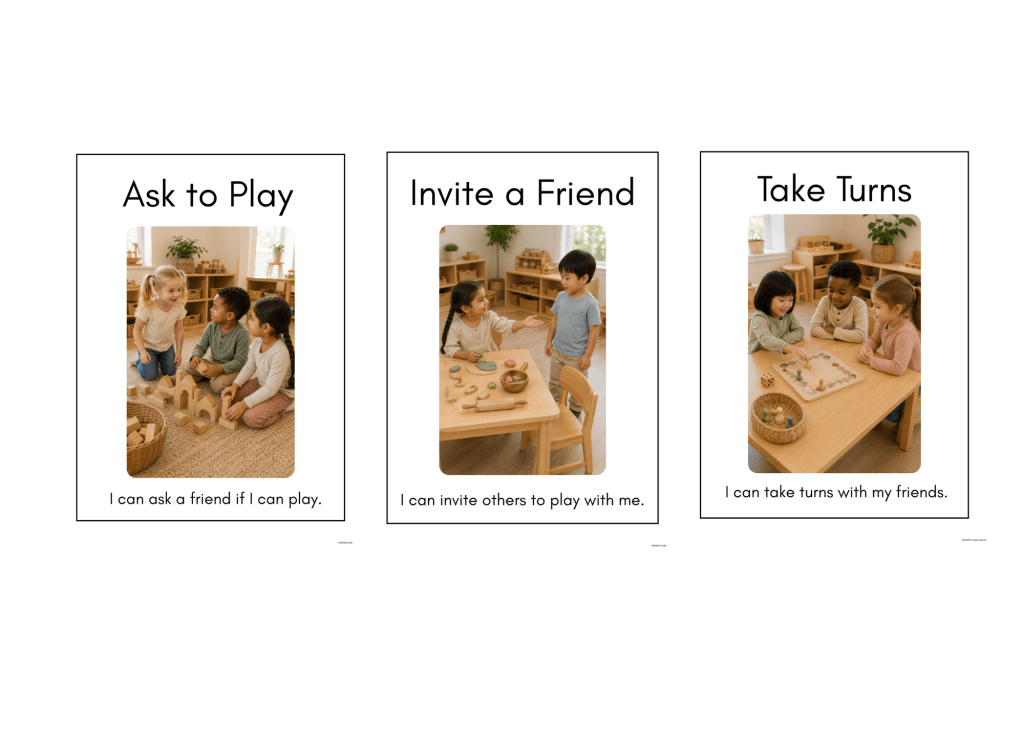
Instead of assuming children know how to enter play, we can teach specific strategies:
- Ask, “Can I play?”
- Ask what the children are doing.
- Offer an idea that fits the play already happening.
- Find a way to contribute.
- Watch briefly before joining.
- Ask another child to play.
These are skills children can practice during calm classroom moments—not only when someone is already standing outside a group feeling left out.
When Something Doesn’t Go the Way a Child Expected
The block tower falls.
Someone else gets the blue cup.
The puzzle piece won’t fit.
The class can’t go outside because it’s raining.
A friend doesn’t want to play the same game.
Small disappointments are part of every preschool day.
And they’re also opportunities to build flexibility.
A child may need help learning to:
- Take a breath.
- Try again.
- Ask for help.
- Choose another option.
- Accept a small change.
- Decide whether the problem is something they can solve or something they need to let go.
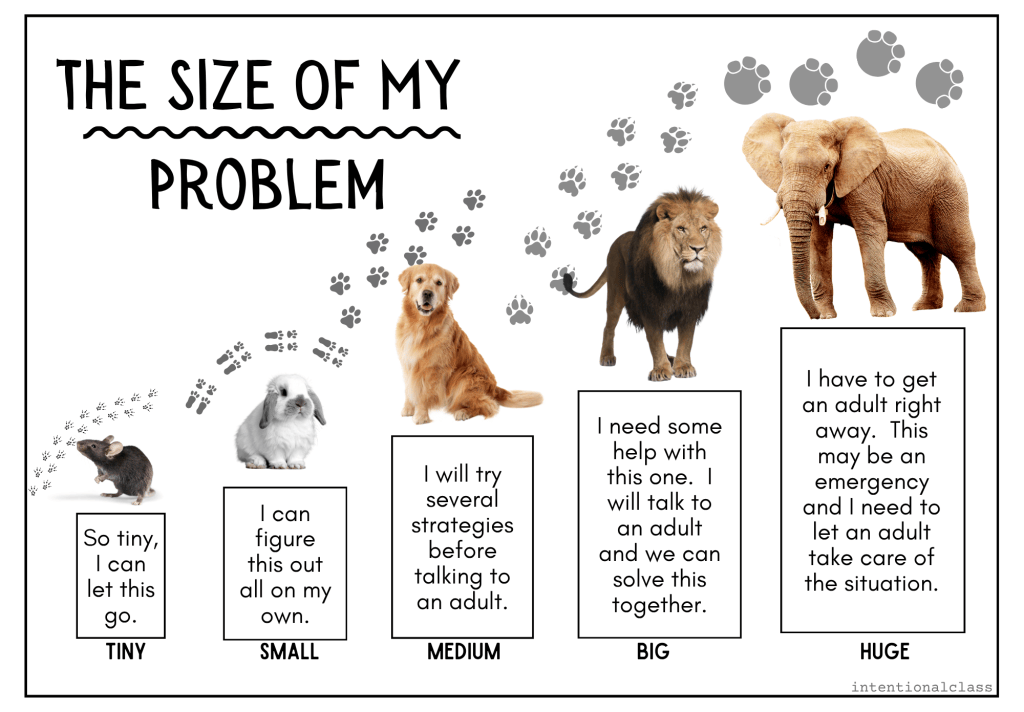
This is also where helping children think about the size of a problem can be useful.
Not every problem needs the same response.
A broken crayon and someone getting hurt are both problems, but they require very different levels of adult help and emotional response.
Helping children begin to notice those differences can support more flexible problem solving over time.
“Use Your Words” Is a Start—But Which Words?
This is another phrase many of us use with good intentions.
“Use your words.”
But imagine being four years old, angry, and in the middle of a conflict.
Which words?
That’s the part we sometimes forget to teach.
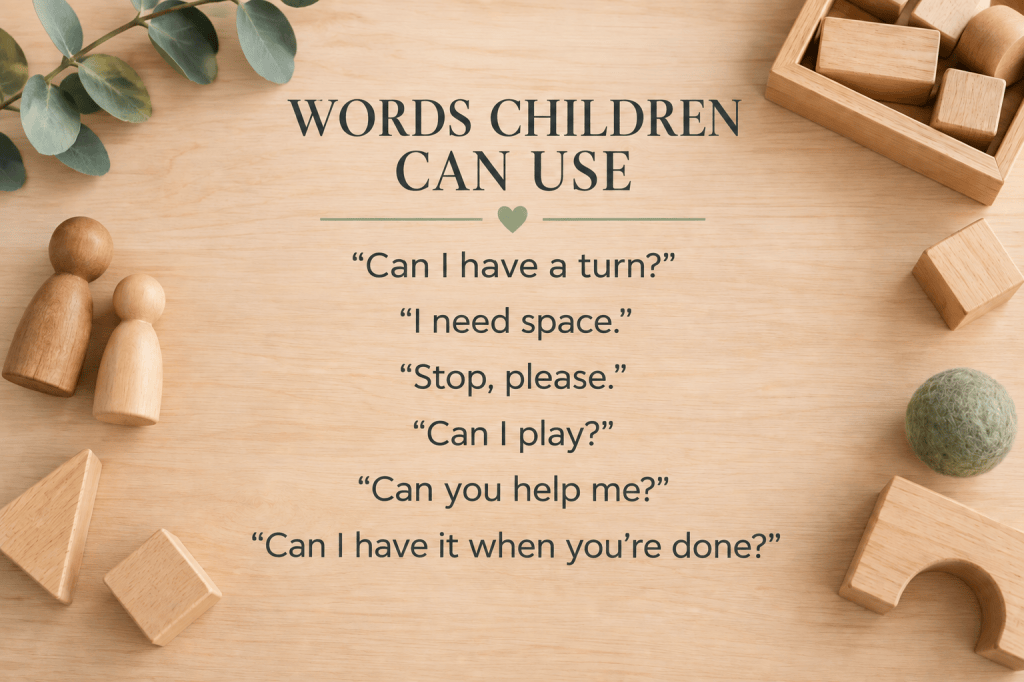
Children may need specific language they can borrow until it becomes their own:
“Can I have a turn?”
“I need space.”
“Stop, please.”
“Can I play?”
“Can you help me?”
“I’m still using this.”
“Can I have it when you’re done?”
Specific language gives children something concrete to try.
As their communication and social problem-solving skills grow, they become less dependent on adult scripts.
Give Children Choices They Can Actually Use
“Make a good choice” assumes a child already knows what the good choices are.
Sometimes they don’t.
Instead, try making the possibilities concrete.
A child who wants a toy might hear:
“You can ask for a turn, wait, or choose something else.”
A child who feels crowded might hear:
“You can tell her you need space or move to another spot.”
A child struggling with a friend might hear:
“You can tell him what you need, think of another solution, or ask me for help.”
We’re not giving children unlimited control over the situation.
We’re teaching them that even when they can’t control what another person does, they usually have choices about what they do next.
That is a powerful skill.
Teach Problem Solving Before the Problem
Some of the best behavior teaching happens when there isn’t currently a behavior problem.
If the first time we discuss grabbing is while two children are fighting over a truck, we’re trying to teach a new skill at the hardest possible moment.
Instead, use calm times to talk about common classroom situations.
During a morning meeting or small group, you might ask:
“What could you do if someone has the toy you want?”
“What could you do if you want to join someone’s game?”
“What could you do if a friend says no?”
“What could you do if someone is too close to you?”
Let children think of possibilities.
Talk about which choices are safe and helpful.
Role-play them.
Use photographs or visual supports.
Practice the words.
Then, when the real situation occurs, you have something familiar to reference.
Instead of a long lecture in the middle of a conflict, you may only need to say:
“Remember what we practiced. What could you do?”
Visual Supports Make Abstract Skills More Concrete
Preschool problem solving involves concepts that can be surprisingly abstract.
Wait.
Be flexible.
Solve the problem.
Make a good choice.
Use your words.
Those phrases make sense to adults because we already understand the behaviors behind them.
Young children may not.
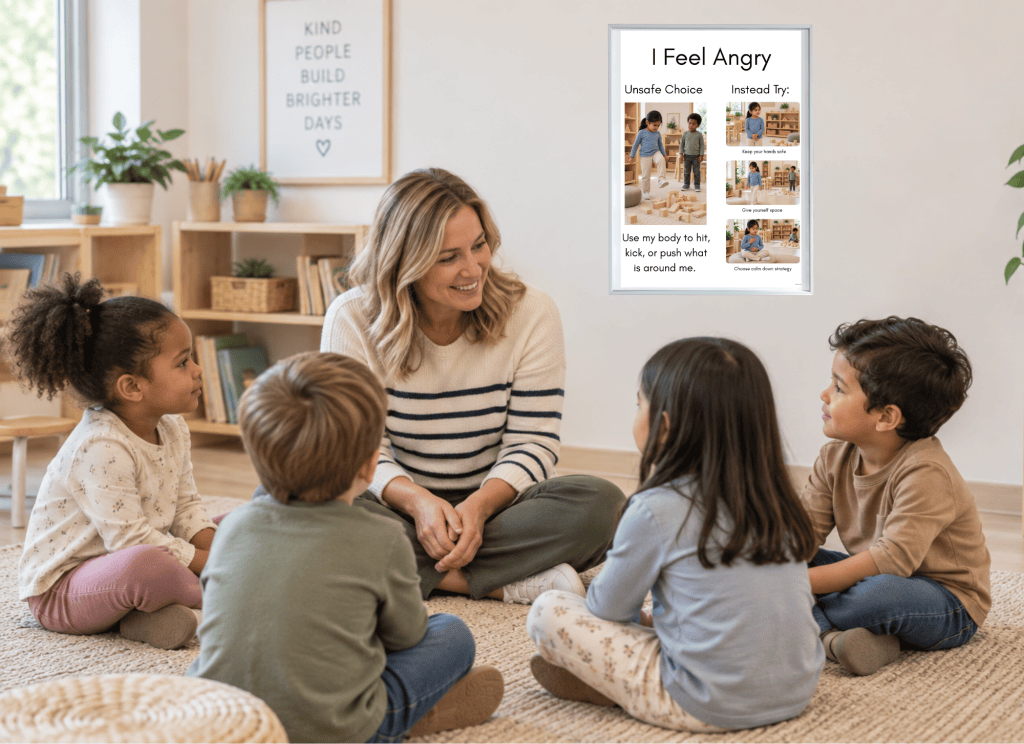
Visual supports can make the options more concrete.
Instead of only hearing “make a good choice,” a child can see several possible choices.
Instead of only hearing “solve the problem,” the child can look at possible solutions.
And instead of relying on an adult to repeat the same directions every time, the visual becomes a familiar reference the child can return to.
This is one reason I like using the same visual language during direct teaching, small-group practice, and real classroom situations.
The support is already familiar when the child needs it.
Don’t Solve Every Problem for Them
This may be the hardest part.
When you’ve worked with young children for a long time, it’s easy to see the solution almost immediately.
“You take this truck. You take that truck. Problem solved.”
And sometimes we do need to step in.
But when the situation is safe and developmentally appropriate, we can also resist solving every problem for children.
Try moving from telling to prompting.
Instead of:
“Give him that one and take this one.”
Try:
“You both want the truck. What could you do?”
If they don’t know:
“Could you take turns, find another truck, or think of another idea?”
If they’re still stuck, model a solution.
The goal isn’t to withhold help.
It’s to provide just enough help for the child to take the next step.
Over time, we want the progression to look something like this:
Adult solves the problem → Adult offers choices → Adult prompts the child → Child chooses a strategy → Child begins solving familiar problems independently.
That’s where the real growth happens.
The Goal Isn’t Perfect Behavior
Preschoolers are going to grab.
They’re going to interrupt.
They’re going to become frustrated.
They’re going to forget the strategy you practiced yesterday.
They’re going to know exactly what they’re supposed to do and occasionally do something else anyway.
Learning social and emotional skills isn’t a straight line.
The goal isn’t a classroom where children never have problems.
A healthy preschool classroom will have plenty of problems because young children are learning how to live, play, communicate, and cooperate with other people.
The goal is to give them more tools for handling those problems over time.
Every time we help a child name a problem, consider a choice, try a solution, communicate with a friend, or ask for help appropriately, we’re adding another tool.
And eventually, we start hearing the language we’ve modeled coming from the children themselves.
“Can I have it when you’re done?”
“I need some space.”
“Can I play too?”
“Let’s take turns.”
“Can you help me?”
That’s the progress we’re looking for.
A Simple Preschool Problem-Solving Framework
When a problem happens, remember these four ideas:
UNDERSTAND
How big is the problem?
Help children recognize what happened and begin thinking about whether it is something they can solve.
CHOOSE
What could I do?
Give children concrete, appropriate options instead of only telling them what not to do.
SOLVE
What can I do to solve it?
Help children try a solution and see what happens.
CONNECT
What social skill can help?
Practice the communication, friendship, and cooperation skills children can use again in future situations.
The more familiar this process becomes, the less dependent children need to be on an adult telling them exactly what to do.
Looking for Visual Support for Preschool Problem Solving?
I created the Preschool Problem Solving & Behavior Choices Bundle to bring these skills together in one coordinated set of visual resources.
The bundle includes:
- Behavior Choices Visuals
- What Can I Do? Problem Solving Visuals
- Size of My Problem
- Friendship & Social Skills Posters
Together, the resources help children understand problems, consider choices, find solutions, and build the social skills they need to navigate everyday preschool situations.
They can be used during whole-group SEL lessons, small-group discussions, individual support, or naturally occurring classroom problems.
Teach the Skill, Not Just the Rule
There will always be moments when we need to say “stop” or “no.”
But we don’t have to end there.
We can show children what safe hands look like.
We can teach the words they can use.
We can give them choices.
We can help them think of solutions.
We can practice when everyone is calm.
And little by little, we can hand more of the problem solving over to them.
Because the goal isn’t simply getting a preschooler to stop doing something we don’t want.
It’s helping them learn what they can do instead.
 The Intentional Classroom Co
Leave a comment