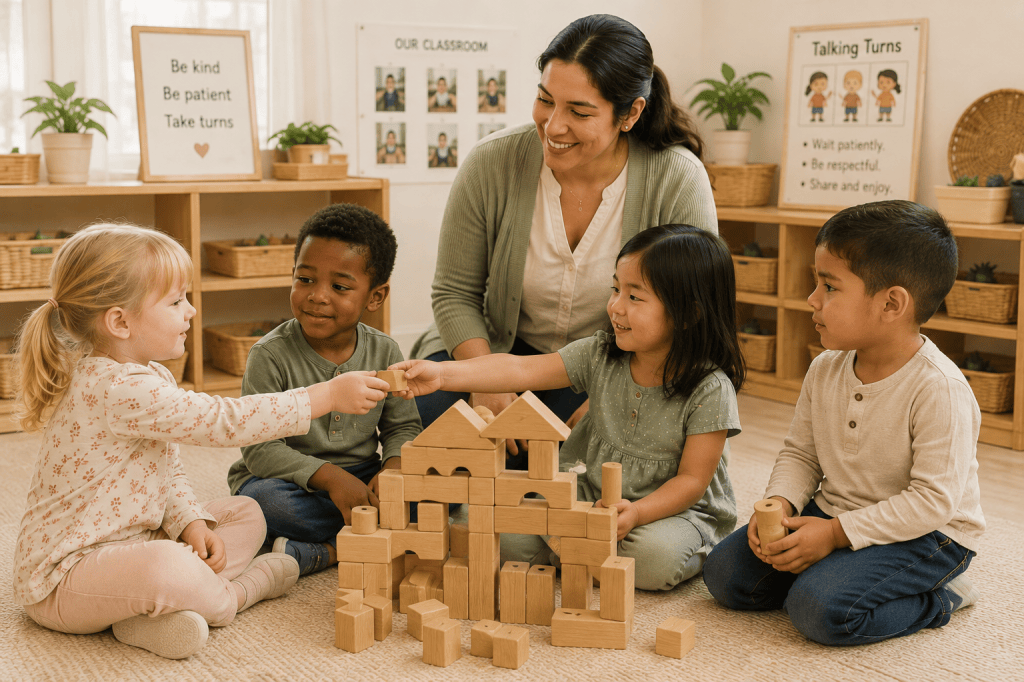
Helping young children build patience, cooperation, and lifelong social skills through intentional teaching.
If you’ve ever found yourself saying…
“Wait your turn.”
“Let your friend have a turn.”
“You already had a turn.”
…more times than you can count during the school day, you’re certainly not alone.
For many preschool teachers, taking turns is one of the most common social challenges in the classroom. Whether children are gathered around the block center, waiting for a chance to answer during circle time, or sharing classroom materials, conflicts often arise because multiple children want the same thing at the same time.
It can be frustrating. You may feel like you’re constantly reminding children to wait, share, and be patient, only to find yourself repeating the same words again a few minutes later.
The good news is this:
Most children aren’t refusing to take turns—they simply haven’t learned how yet.
Taking turns is not a behavior that develops automatically. It is a complex social skill that requires children to practice self-control, manage big emotions, communicate with others, and understand that everyone deserves an opportunity to participate.
Like learning to recognize letters or count objects, taking turns is a skill that benefits from explicit instruction, guided practice, and repeated opportunities to apply what has been learned in real classroom situations.
When we intentionally teach children how to take turns, rather than simply reminding them to take turns, we help them build skills that will support friendships, classroom success, and positive relationships for years to come.
Why Is Taking Turns So Difficult for Preschoolers?
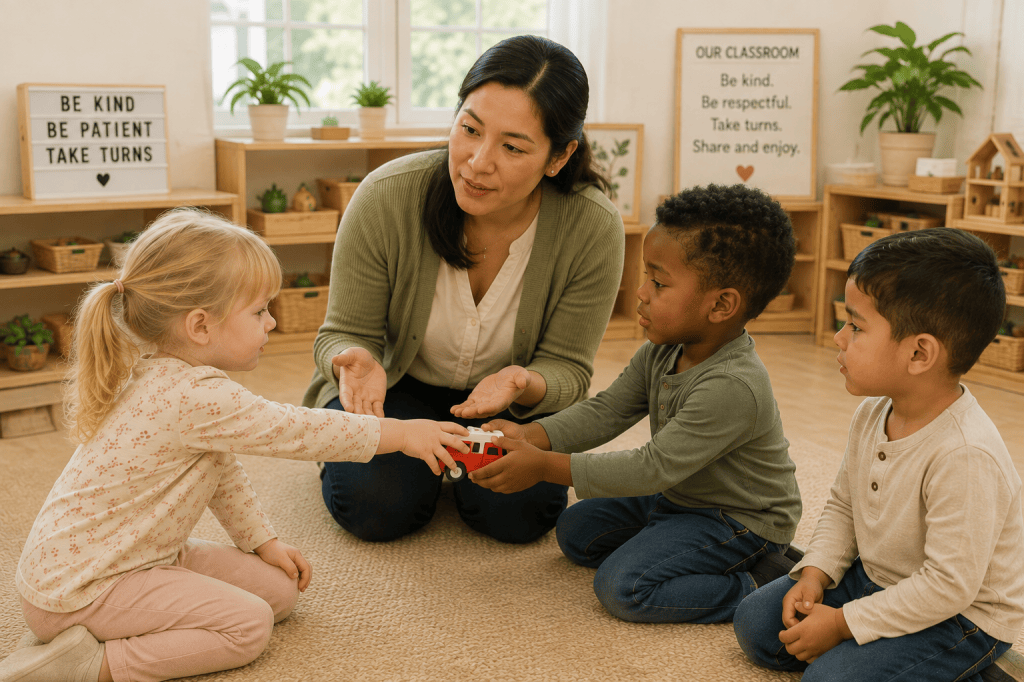
Adults often assume that waiting for a turn is a simple expectation. From a child’s perspective, however, taking turns can feel incredibly difficult.
Young children are still developing the executive functioning skills that allow them to:
- Wait for something they want
- Control impulses
- Manage disappointment
- Think about another person’s perspective
- Solve social problems
- Communicate appropriately while waiting
Imagine seeing your favorite toy sitting just a few feet away while another child is using it. You know you’ll eventually have a chance, but waiting feels impossible. For many preschoolers, those emotions are very real.
This doesn’t mean children are being selfish or intentionally difficult. It simply means they’re still developing the skills needed to navigate these situations successfully.
Understanding this shift—from seeing behavior as disobedience to recognizing it as a developing skill—changes how we respond as educators.
Instead of asking, “Why won’t they listen?” we begin asking, “What skills do they still need to learn?”
That question leads to much more effective teaching.
Why Constant Reminders Usually Don’t Work
It’s easy to fall into the habit of repeating the same reminders throughout the day:
“Wait your turn.”
“Share with your friends.”
“Be patient.”
While these reminders may stop a situation in the moment, they rarely teach children what the behavior actually looks like.
Imagine trying to teach a child to write their name by simply saying, “Write better.”
Without modeling, practice, feedback, and encouragement, learning would be slow and frustrating.
Behavior works much the same way.
Children benefit most when adults explicitly teach:
- what taking turns looks like,
- why it matters,
- when they will need the skill,
- and how to respond when waiting feels difficult.
When instruction replaces constant correction, children begin building independence instead of relying on adult reminders.
What Taking Turns Actually Looks Like
Many adults think of taking turns only during games.
In reality, children practice turn-taking dozens of times throughout every school day.
Examples include:
- Waiting to answer a question during Morning Meeting
- Taking turns speaking during class discussions
- Sharing classroom materials
- Waiting for a favorite center
- Using dramatic play props together
- Building with blocks as a group
- Taking turns at the sensory table
- Waiting for a turn on playground equipment
- Choosing classroom jobs
- Standing patiently in line during transitions
When children recognize that taking turns happens in many different situations, they begin transferring the skill from one activity to another.
Five Strategies That Help Children Learn to Take Turns
1. Teach the Skill Before Problems Occur
The best time to teach taking turns isn’t during a conflict—it’s before one happens.
Introduce the concept during Morning Meeting or a small-group lesson when children are calm and ready to learn. Use photographs, stories, and discussion questions to explore what taking turns looks like and why it helps everyone enjoy classroom activities together.
2. Model the Language You Want Children to Use
Children learn just as much from what we say as from what we ask them to do.
Try modeling phrases such as:
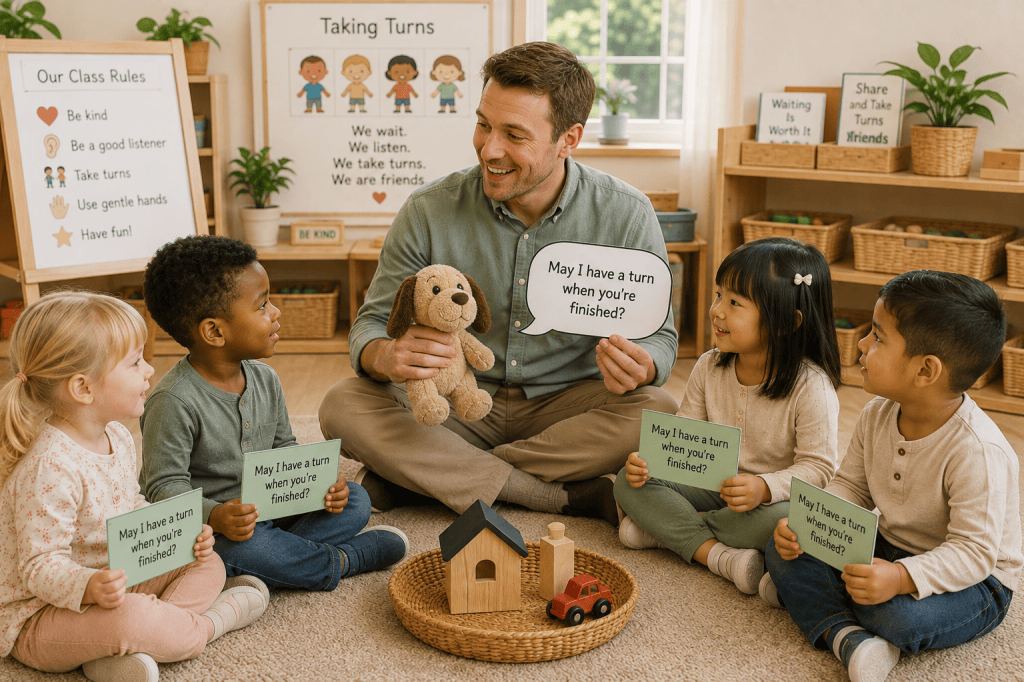
- “May I have a turn when you’re finished?”
- “I’m waiting patiently.”
- “Thank you for sharing.”
- “You can have the next turn.”
Providing children with respectful language gives them practical tools they can use during real interactions.
3. Practice Through Play
Turn-taking becomes meaningful when children experience it during enjoyable activities.
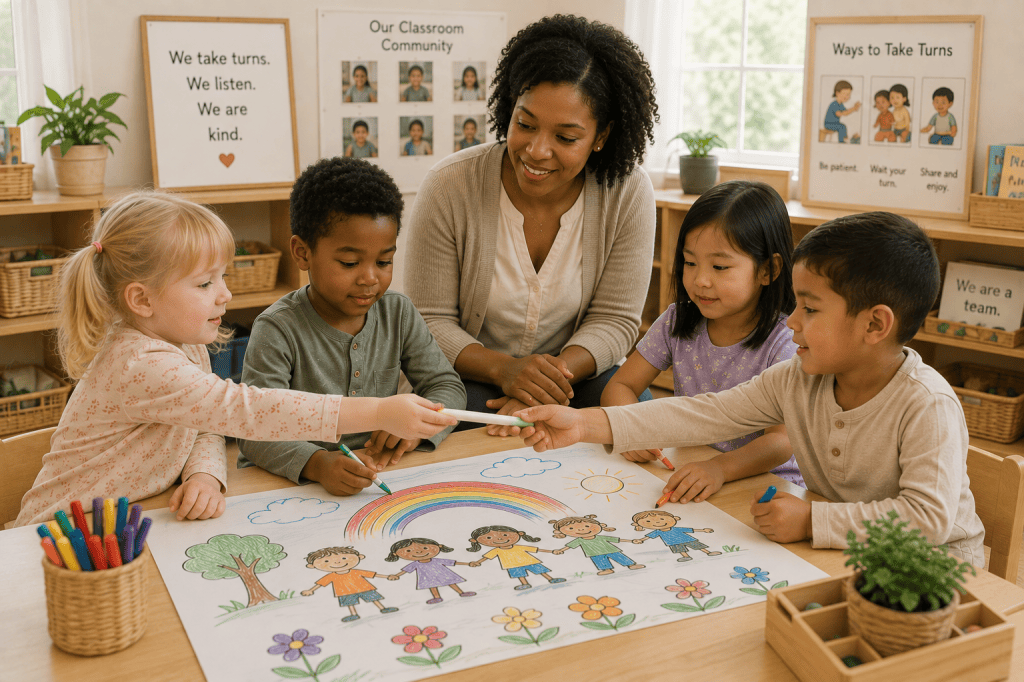
Board games, building challenges, partner art projects, dramatic play, and cooperative classroom centers all provide authentic opportunities to practice waiting, sharing, and communicating with peers.
Practice during calm moments is what prepares children for more challenging situations later.
4. Use Visual Supports
Young children benefit from concrete reminders.
Visual cues, classroom photographs, reminder cards, and simple social stories help children remember expectations without relying solely on verbal reminders from adults.
These supports also encourage greater independence over time.
5. Celebrate Success
Instead of focusing only on moments when children struggle, intentionally notice when they demonstrate the skill successfully.
Comments such as:
“I noticed you waited patiently while your friend finished.”
“You remembered to ask for a turn so kindly.”
“That was thoughtful of you to let your friend go first.”
help reinforce the behavior you want to see more often.
Specific praise builds confidence and encourages children to continue practicing positive social skills.
Why Real Photographs Make a Difference
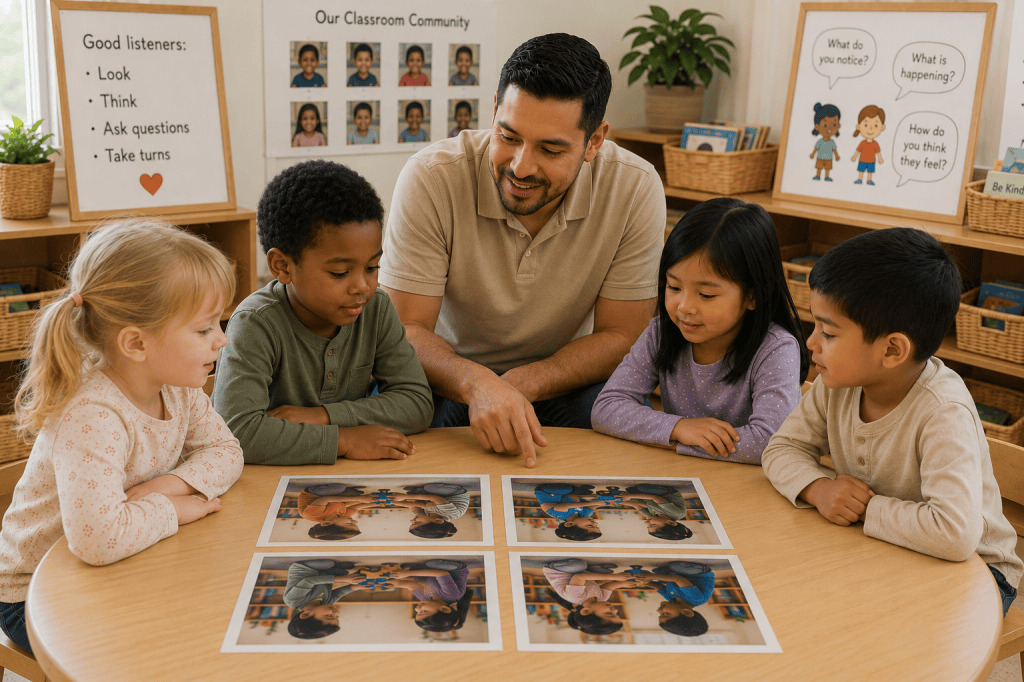
Young children learn best when they can connect new ideas to real-life experiences.
While illustrations can certainly be engaging, authentic classroom photographs provide children with recognizable examples of everyday situations they are likely to encounter.
When children see real preschool classrooms, real materials, and real peers demonstrating positive behavior, they are better able to transfer those behaviors into their own classroom experiences.
Photographs also encourage richer classroom conversations.
Instead of asking children to memorize a rule, teachers can ask:
- What do you notice?
- Whose turn is it?
- How can you tell?
- What might happen next?
- What could the children do if they both want the same toy?
These open-ended discussions promote critical thinking, empathy, and problem-solving rather than simply teaching children to repeat expected answers.
Simple Taking Turns Activities You Can Try Tomorrow
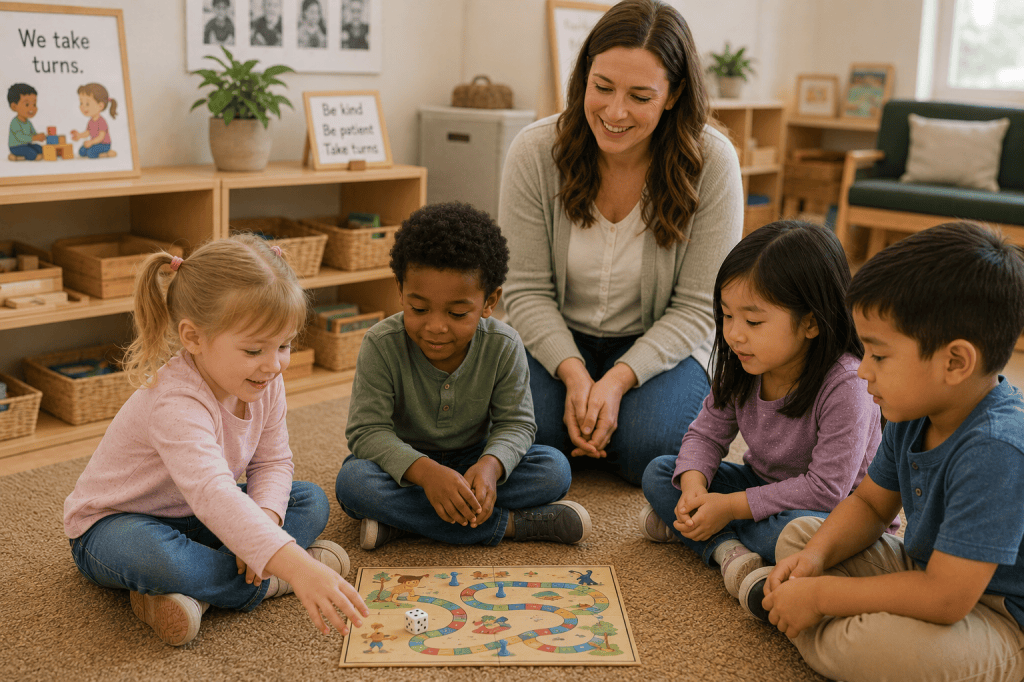
Teaching turn-taking doesn’t require complicated materials. Some of the most effective opportunities happen during everyday classroom routines.
Here are a few simple ideas:
Build One Together
Invite a small group of children to create a single block structure.
Each child adds one block before the next child has a turn.
Talk about how waiting helps everyone contribute.
Pass the Basket
Place classroom materials in one basket.
Children practice politely passing the basket around the table before choosing one item.
Partner Drawing
Provide one set of markers for two children.
Encourage children to ask politely for a turn and thank their partner when sharing materials.
Roll and Build
Children roll a die.
Each child completes one action before passing the die to the next player.
This naturally reinforces waiting and cooperation.
Story Discussion
Read a story that includes sharing or waiting.
Pause throughout the story to ask children what they think the characters should do next.
When Children Need Extra Support
Some children require additional opportunities to practice social skills.
That is perfectly normal.
Consider providing:
- Small-group instruction
- Visual reminder cards
- Social stories
- Teacher modeling
- Partner practice
- Frequent positive reinforcement
- Predictable routines
Learning social behavior takes time.
Every successful interaction builds confidence.
A Complete Resource for Teaching Taking Turns
If you’re looking for a ready-to-use resource that brings all of these strategies together, the Taking Turns unit from the Intentional Behavior Collection™ provides everything you need to confidently teach this important social skill.
The collection follows a consistent six-step teaching framework:
- Let’s Learn — Introduce the behavior skill.
- Let’s Practice — Build confidence through engaging activities.
- Let’s Solve It! — Apply learning through real-life situations.
- Let’s Remember — Reinforce the skill throughout the day.
- Let’s Connect — Extend learning at home.
- Let’s Celebrate — Recognize children’s growth and success.
The Taking Turns unit includes:
- Teacher Guide
- Teaching Posters
- Mini Lesson
- Guided Discussion
- Role-Play Challenge Cards
- Real Photo Scenario Cards
- Narrative Story
- Sorting Activity
- Reminder Cards
- Parent Letter
- Home Connection Activity
- Student Certificate
Every component is designed to help children understand, practice, and independently use taking-turns skills in meaningful classroom situations.
Final Thoughts
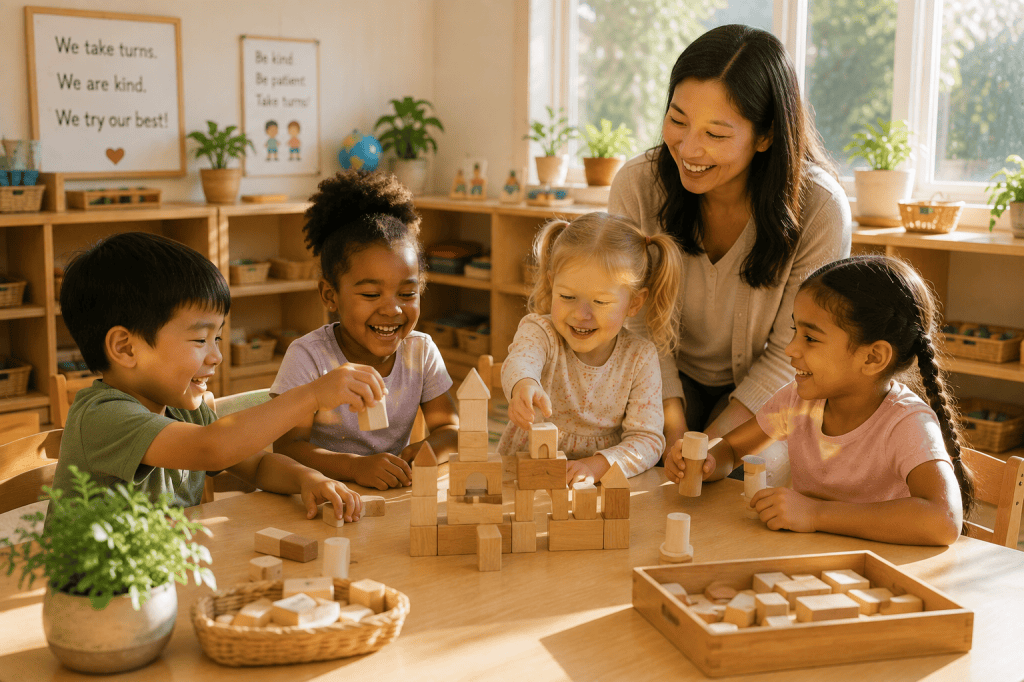
Teaching children to take turns isn’t about creating perfectly patient preschoolers overnight.
It’s about giving them the tools they need to succeed.
Every time we intentionally teach, model, practice, and celebrate positive behavior, we help children build skills that extend far beyond the classroom.
A child who learns to wait patiently today is also learning empathy.
A child who shares materials with a friend is developing cooperation.
A child who asks politely for a turn is building communication skills that will support healthy relationships for years to come.
Positive behavior doesn’t happen by accident.
It grows through intentional teaching, meaningful practice, and caring adults who believe every child is capable of learning.
And that’s exactly what the Intentional Behavior Collection™ is designed to support.
 The Intentional Classroom Co
Leave a comment