If you’ve spent any time in an early childhood classroom recently, you’ve without a doubt noticed a significant shift. Teachers across the country are reporting that more children are struggling with self-regulation than ever before. Challenging behaviors are on the rise everywhere, leaving veteran teachers scratching their heads and asking, “What is happening here?”
Children are having difficulty waiting, managing frustration, transitioning between activities, solving problems with peers, and regulating their bodies when their expectations are not met. AKA, having extreme reactions when they experience disappointment. Behaviors that once occurred occasionally are now occurring with greater frequency and at a higher level than ever before.
For teachers, this shift is becoming overwhelming.
The good news is that children’s behavior is not simply getting “worse.” Instead, many children are entering classrooms with fewer opportunities to develop the foundational self-regulation skills they need to navigate a group environment, such as a busy preschool classroom.
Understanding why this is happening is the first step toward providing supportive solutions.
What Is Self-Regulation?
Self-regulation is a child’s ability to manage their emotions, behaviors, and responses to challenges or demands.
Self-regulation allows children to:
- Wait for a turn
- Follow classroom expectations
- Recover from disappointment
- Express feelings appropriately
- Transition between activities
- Solve problems with peers
- Persist through challenges
These skills will not develop automatically. Like learning letters or counting, self-regulation requires practice, guidance, and support.
Why Are More Children Struggling?
Self-Regulation Skills Are Developing Later
Many educators report that children are entering classrooms with little to no experience managing frustration, waiting, solving peer conflicts, and coping with disappointment. We know this because of the larger reactions occurring with greater consistency. Behaviors such as hitting, pushing, screaming, throwing items, spitting, and the inability to control emotions are not unheard of in a preschool classroom. Clearly, there is a disconnect, and children are having more difficulty finding appropriate and effective ways to regulate.
Regulation skills are not something that children simply “have.” They develop through repeated practice over time.
Self-regulation grows when children:
- Wait for turns
- solve problems with peers
- engage in imaginative play
- navigate boredom
- practice flexibility
- interact with responsive adults
When these experiences decrease, opportunities to strengthen regulation skills decrease as well. One of the biggest obstacles to a child learning developmentally appropriate regulation skills is screen time.
The Impact of Screen Time on Self-Regulation
Screen time is not inherently harmful. Technology can be educational, engaging, and useful when used intentionally and sparingly.
However, the latest research consistently shows associations between high levels of screen exposure and weaker executive functioning skills, including attention, inhibitory control, cognitive flexibility, and self-regulation.
Several studies have found that children with greater screen exposure during the toddler and preschool years tend to demonstrate lower levels of self-regulation and executive functioning later in childhood. As ECE educators can attest, children who are used to screen time tend to have the biggest challenges when faced with disappointment or unmet expectations.
Research has also shown that increased screen use may reduce opportunities for experiences that help children develop regulation skills, such as caregiver interactions, conversations, free play, and peer engagement. Additionally, when a child is used to the instant gratification provided by devices, they do not know how to regulate when they don’t get it in real life. A preschool classroom is all about routines, structure, transitions, learning, and expectations. Without appropriate regulations and skills, a child is going to become stressed and overwhelmed.
Parent Screen Use Matters Too
One area receiving increased attention is not just children’s screen use, but adult screen use.
Children learn self-regulation through thousands of interactions with responsive adults. When adults are frequently distracted by phones, tablets, or other devices, opportunities for conversation, emotional coaching, and social connection can decrease. Children want to engage and learn, so when they seek that out and are ignored, not only are those skills not going to be learned, but negative attention-seeking skills can develop.
Researchers have also found that screen exposure is associated with reduced parent-child interaction and fewer language-rich conversations. Children are constantly learning new words. By reducing that interaction, that child is not only losing the opportunity for literacy growth but also the connection they are seeking.
This does not mean parents are knowingly doing anything wrong. Modern families are balancing work, communication, scheduling, and countless responsibilities through technology. However, protecting opportunities for face-to-face interaction remains critically important for children’s development.
The Loss of Boredom, Play, and Problem-Solving
Children develop regulation skills when they experience manageable challenges.
They learn persistence when a tower falls.
They learn flexibility when a friend wants a different role in pretend play.
They learn to tolerate frustration when they have to wait.
When every moment is filled with adult-directed activities or digital entertainment, children may have fewer opportunities to practice these essential skills.
Play is not separate from self-regulation development—it is one of the primary ways self-regulation develops.
A More Complex Picture
A single factor cannot explain the increase in self-regulation challenges.
It is likely the result of multiple influences working together, including:
- increased screen exposure
- Reduced opportunities for unstructured play
- fewer chances to practice problem-solving
- higher levels of family stress
- changing expectations for young children
The goal is not to blame families or technology. The goal is to understand why children may need more support today and how educators can intentionally teach the skills that help children succeed.
What Can Teachers Do?
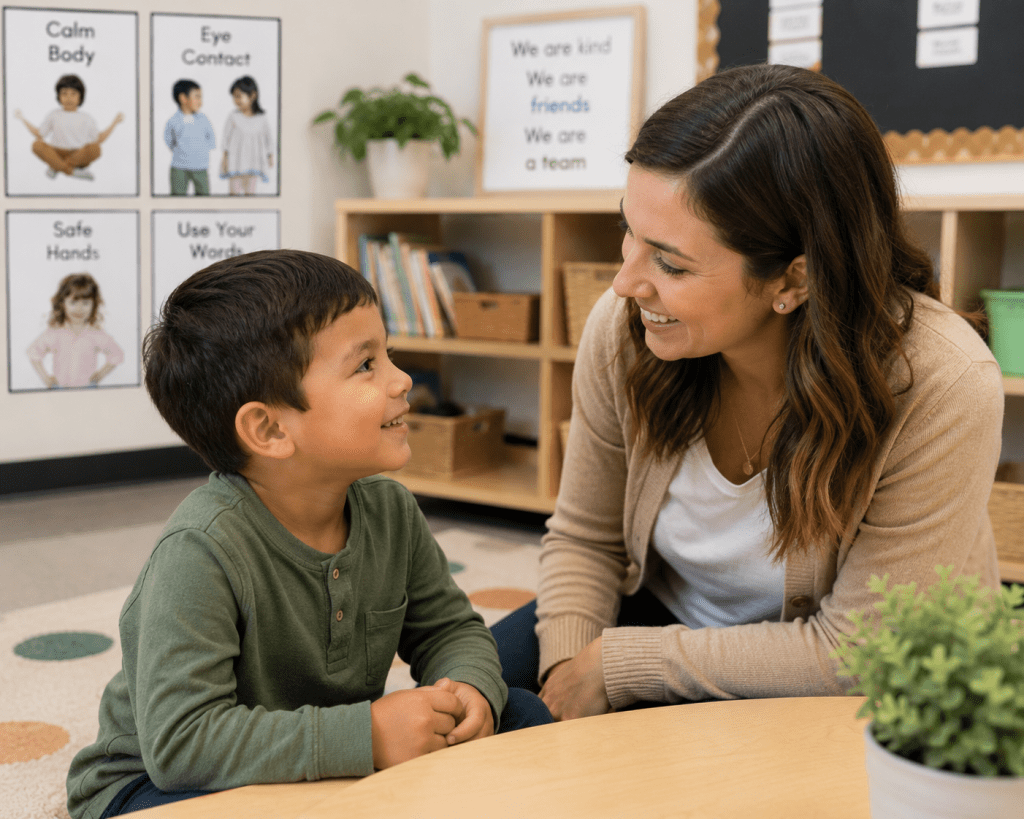
Although teachers cannot control every factor affecting children’s development, they can create environments that actively support self-regulation growth.
Focus on Teaching, Not Punishing
Self-regulation is a skill deficit, not a character flaw.
We all have those children in our classrooms. These children are the ones that are the ones you will find running laps around the classroom, knocking over a chair, dumping buckets of toys, or simply refusing to join any part of your day. As exhausting and frustrating as this can be, we need to change our mindset when responding.
Instead of asking, “How do I stop this behavior?” consider asking:
“What skill is this child missing?”
When a child shows us all these behaviors, they are missing the skills to respond appropriately. Instead of cleaning up their toys when it is time to transition to lunch, they throw another bucket across the room. Instead of sitting on the group rug to start the morning meeting, they join their own race around the classroom. There are reasons for these actions, and they are not meant to disrupt your day or cause you frustration.
When a child is struggling in the classroom, their behaviors can tell you something about them. Their reaction is saying, “I’m tired, I’m frustrated, I’m overwhelmed, or I’m anxious.” These children often need instruction, modeling,practice, patience, and understanding rather than punishment.
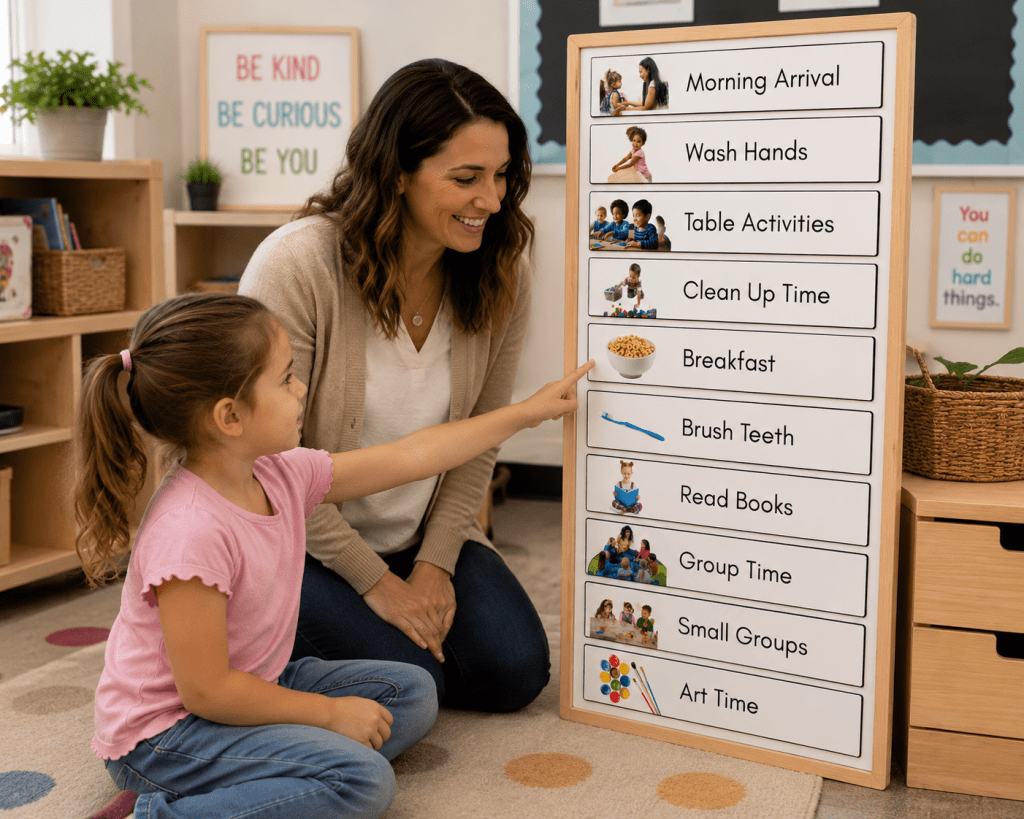
Create Predictable Routines
Predictability helps children feel safe.
Consistent schedules, visual supports, and clear expectations reduce anxiety and allow children to focus their energy on learning rather than figuring out what comes next.
- Create a movable visual schedule so that, when your day inevitably changes, you can demonstrate it by moving the activities.
- Use the same transition procedures, such as a song or bell, for each activity so that students know what is coming next.
- Give consistent timing warnings, such as five, two, and one-minute warnings, with a large, visual timer.
Use Visual Supports
Examples of your go-to visual supports include:
- First/Then Boards
- Moveable Daily Schedule
- Emotions Chart
- Emotions Check In
- Feelings Vocabulary
- Large Timers
Having these additional supports can make all the difference when creating routine and supporting regulatory skills.
Teach Emotional Vocabulary
Children cannot communicate feelings they do not understand.
Providing language for emotions helps children identify what they are experiencing and communicate their needs more effectively.
Simple statements such as:
- “You seem frustrated.”
- “It looks like you’re disappointed.”
- “Your body looks excited.”
Simple statements and identification can help children build emotional awareness.
Practice Self-Regulation Before Problems Occur
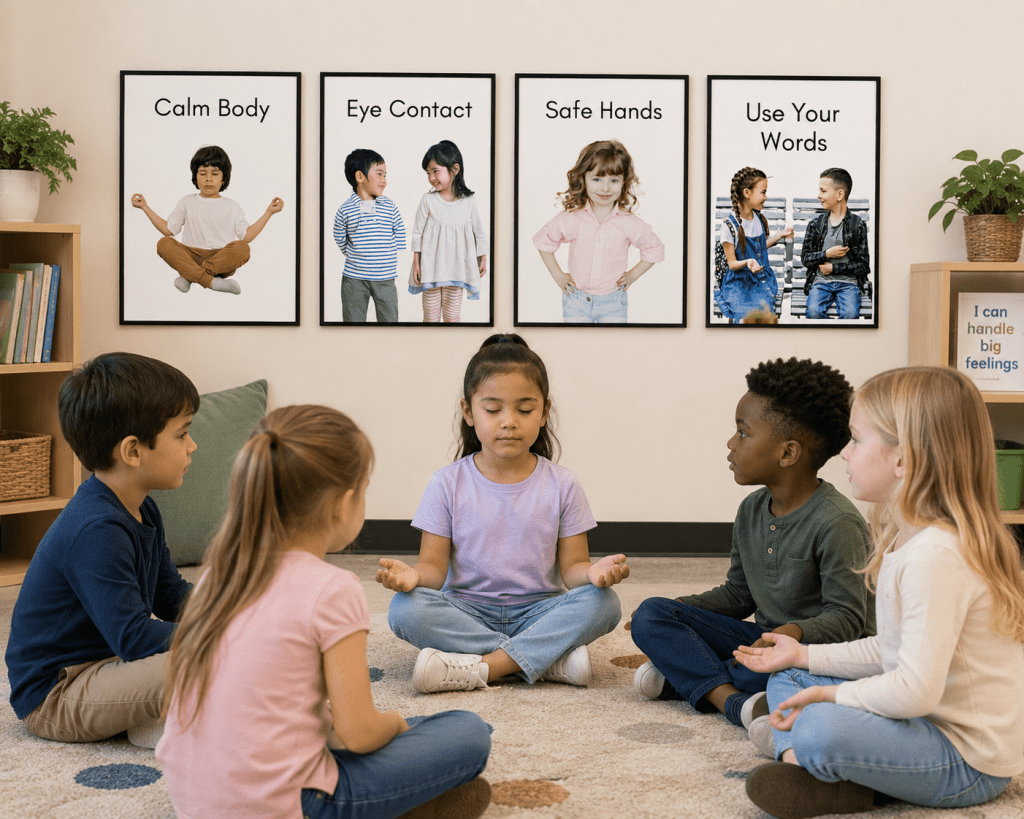
The best time to teach self-regulation is NOT during a meltdown. These skills need to be taught, repetitively, when a child is in a calm state of mind.
Build regulation skills throughout the day through:
- breathing exercises
- movement breaks
- mindfulness activities
- role-playing
- social-emotional learning discussions
These experiences strengthen children’s ability to use strategies when challenges arise.
Progress Take Time
One of the most important things educators can remember is that self-regulation develops gradually. No new skill is going to be learned through one lesson.
Children do not learn skills overnight. They learn through hundreds of opportunities to practice, make mistakes, receive support, and try again.
When adults consistently provide guidance, structure, and understanding, children develop the skills they need to manage emotions and navigate social situations successfully.
Final Thoughts
The increase in self-regulation challenges can feel discouraging, challenging, and completely overwhelming. Instead of feeling defeated, change your mindset and see these moments as opportunities.
As educators, we can intentionally teach the skills children need most.
When we shift our focus from managing behavior to building skills and recognizing that behaviors are a form of communication, we create classrooms where children feel supported, capable, and successful.
Self-regulation is not something children either have or do not have. It is a skill that can be taught, practiced, and strengthened every day.
 The Intentional Classroom Co
Leave a comment