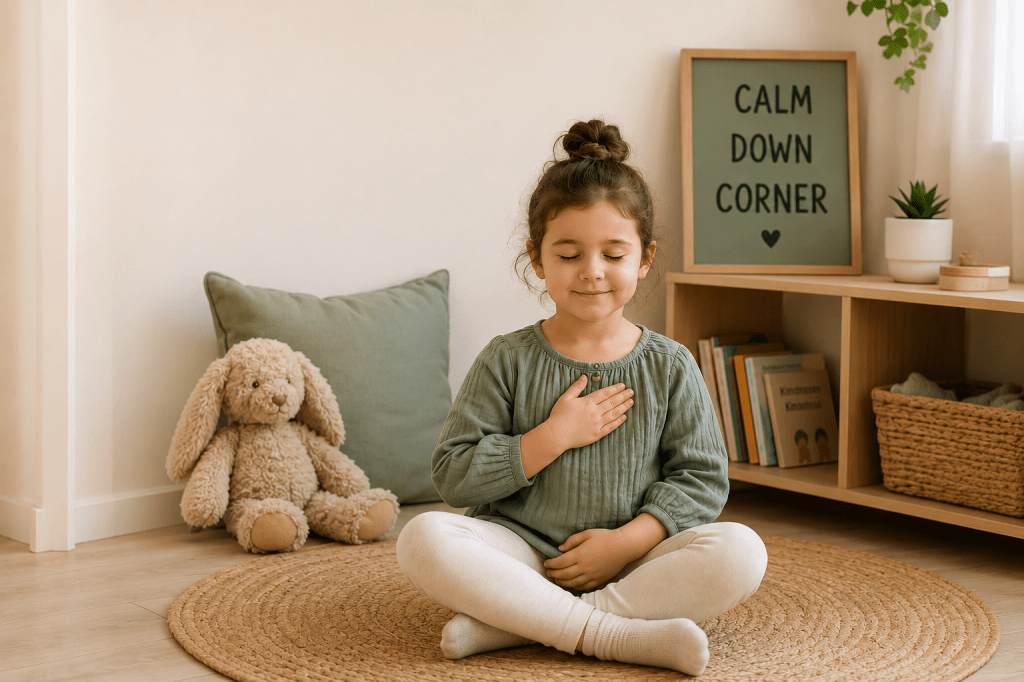
When you hear the phrase “kindergarten readiness”, we often think of academics: reading, writing, and arithmetic. While these skills are important, another foundational skill often has an even greater impact on a child’s success in school: emotional regulation.
Emotional regulation is a child’s ability to recognize, understand, and healthily manage their emotions. It helps a child cope with their frustrations and disappointment. It is also an essential skill when following directions, solving problems, and making friends. Simply put, learning cannot happen if a child is dysregulated and is unable to manage their emotions. Therefore, children who enter kindergarten with strong emotional regulation skills are often better prepared to learn, participate in classroom activities, and navigate the challenges of this new school experience.
What Is Emotional Regulation?
Emotional regulation does not mean that children are not experiencing big feelings. In fact, feeling angry, frustrated, excited, disappointed, or nervous is a normal part of development. They should be feeling and recognizing their emotions. In fact, it is important that children understand that it is OK to feel what they are feeling. We don’t ever want a child to feel shame or embarrassment for having emotions.
Helping a child understand what we do with the big emotions they are feeling is the key.
Emotional regulation is the ability to:
- Identify emotions
- Express feelings appropriately
- Calm down after becoming upset
- Wait for turns and delay gratification
- Cope with challenges and disappointment
- Seek help when needed
For young children, these skills are not automatic. They must be taught, modeled, and practiced over time. Keep in mind that for any new skill a child learns, it takes at least 2 weeks of consistent practice to understand and implement the concept fully. Repetition, understanding, and support will be significant factors when teaching a child to regulate their emotions.
Why Emotional Regulation Is Important for Kindergarten Success
Kindergarten classrooms are filled with new experiences and routines. With that comes new expectations that may be challenging for some. Children are expected to:
- Follow routines
- Listen to directions
- Share materials
- Take turns
- Work with peers
- Transition between activities
- Handle mistakes and challenges
Without emotional regulation skills, even simple situations can feel overwhelming. A kindergarten classroom, in general, is likely a more stimulating environment than what a child is used to. If you add stressors on top of that, it takes some skills in regulating emotions to navigate these challenges.
Imagine a child who becomes frustrated when a puzzle piece does not fit. A child with developing regulation skills may cry, throw the puzzle, or refuse to continue. A child with stronger regulation skills may take a deep breath, ask for help, and try again.
These moments happen every day in kindergarten and directly impact learning. Providing a child with the tools to understand and manage their emotions can directly impact their learning. If you ask a kindergarten teacher about the biggest challenge they face in their classroom, there is a high probability they will say behavior. Challenging behaviors are a direct response to an inability to regulate emotions. To set your child up for success, ensure they can recognize their feelings and work through them in a positive, constructive way.
Emotional Regulation Supports Learning
Research consistently shows that emotional development and academic success are closely connected. It is quite a feat to focus and absorb information when you are emotionally dysregulated. Children need their body in a calm state to learn and retain information.
When children feel calm and safe, they are better able to:
- Focus attention
- Follow directions
- Remember information
- Solve problems
- Participate in group learning
- Engage in conversations
When children are overwhelmed by their big emotions, their brains shift into survival mode. Learning becomes much more difficult because their energy is focused on managing their feelings rather than processing new information. As adults, our brains go into survival mode when we are financially overwhelmed, caring for a sick child, or late for a flight. Think about how you think and feel in those situations, and then remember that you can regulate your emotions. Now imagine what a child feels when they experience the same levels of stress. Could you learn something new in that moment?
If a child’s brain is in survival mode, they have three options: fight, flight, or freeze. The brain will then enter a mode that prioritizes the action best suited to the child’s need in that moment. For example, if a friend takes away a toy the child is playing with and the child’s brain is in survival mode, the child’s immediate need is to get the toy back. To get the toy back quickly, the child may hit, scream, or push to satisfy that immediate need. However, if a child can regulate their emotions, they can use their words or ask for help. It is far easier to navigate their day and continue learning and retaining information.
Simply put, children learn best when they feel emotionally secure and their brain is in a calm state.
Emotional Regulation Builds Strong Relationships
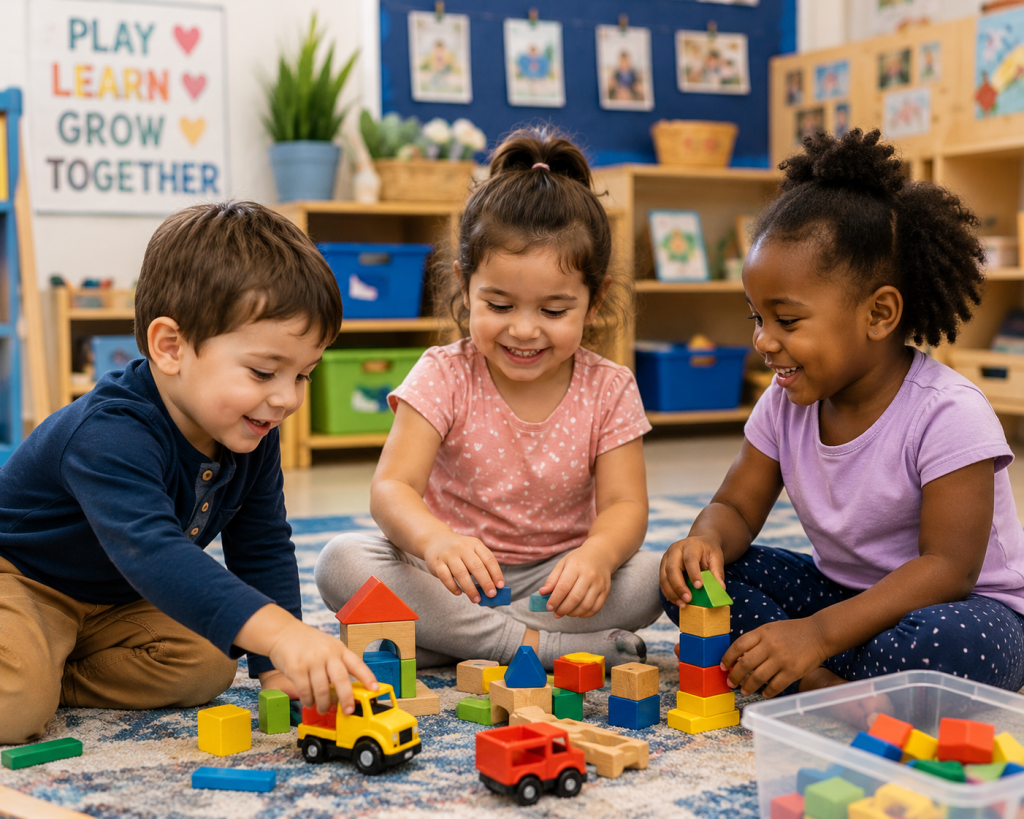
Successful kindergarten experiences are built on positive relationships with teachers and friends. Emotional regulation builds strong relationships because it helps children understand their feelings, communicate their needs appropriately, and respond positively to others. When children can manage emotions such as frustration, disappointment, excitement, or anger, they are more likely to engage in positive interactions with both peers and adults.
Children who can manage emotions are more likely to:
- Use words to solve conflicts
- Cooperate during group activities
- Build friendships
- Show empathy toward others
- Ask for help appropriately
Strong relationships with teachers are equally important. Children who can regulate their emotions are often more receptive to guidance, classroom routines, and constructive feedback. When children feel understood and supported by caring adults, they develop a sense of trust and security that encourages participation and learning.
Ultimately, emotional regulation helps children feel confident in social situations, navigate challenges more effectively, and build healthy relationships that support both their emotional well-being and academic success. These social skills help children feel connected and confident in their classroom community.
Signs a Child Is Developing Emotional Regulation Skills
Every child develops at their own pace, but many kindergarten-ready children are beginning to:
✓ Identify basic emotions such as happy, sad, angry, scared, and excited
✓ Use simple calming strategies
✓ Recover from disappointment within a reasonable amount of time
✓ Follow classroom routines with support
✓ Wait for short periods of time
✓ Express needs using words
✓ Accept guidance from adults
As children develop emotional regulation skills, they begin to demonstrate behaviors that help them navigate friendships and classroom experiences more successfully. These skills provide an important foundation for kindergarten readiness and long-term school success.
It is important to remember that emotional regulation is not about eliminating big feelings. Children will still experience frustration, disappointment, anger, and sadness. The goal is to help them develop the skills needed to manage those emotions in healthy and appropriate ways.
Every opportunity to practice identifying emotions, solving problems, and coping with challenges helps strengthen a child’s ability to regulate emotions and build resilience for future learning and relationships. Try identifying emotions throughout the day, even in normal situations. Statements such as:
“I see that you woke up happy and ready to go to school today!”
“It looks like you have a frown on your face. You look sad. How can I help?”
“I see that losing your toy made you angry. Let’s calm your body and look for it together.”
Keep in mind, children do not need to master these skills before kindergarten. The goal is to understand their emotions and introduce coping mechanisms they can master over time.
Simple Ways to Support Emotional Regulation at Home
The good news is that emotional regulation can be strengthened through everyday experiences.
Name Feelings Throughout the Day
Help children build emotional vocabulary by labeling emotions as they occur.
Examples:
- “You look excited about our trip.”
- “I can see you’re frustrated because the tower fell down.”
- “You seem disappointed that playtime is over.”
Model Healthy Emotional Responses
Children learn how to handle emotions by observing others around them. Every day offers opportunities to demonstrate calm, effective ways to manage stress, frustration, and disappointment.
When challenges arise, as adults, we can model emotional regulation by thinking aloud: “I’m feeling frustrated right now, so I’m going to take a deep breath and try again.” These moments show children that strong emotions are normal and that there are healthy ways to respond to them. Even as adults, we need to recognize and address our own emotions. Modeling that experiencing emotions is an acceptable behavior is an important lesson to teach our children. It is OK to feel and express emotion. Sometimes, without even realizing it, we negate or devalue the emotions children are feeling. Try to avoid the following statements that can put a negative aspect on feeling emotions:
“You’re fine.”
“This is not something that we cry about.”
“You’re being dramatic.”
“Just calm down.”
Although unintentional, the previous statements can negatively affect a child’s ability to recognize and understand emotions. They also convey the message that it is inappropriate for the child to experience their particular emotions. The goal is to name the emotion, understand why they are feeling it, and then learn how to cope with it, not to downplay what they are feeling.
Continue modeling positive, instructive ways to regulate emotions. Over time, children begin to imitate the coping strategies they see modeled by the adults in their lives.
Create Predictable Routines
Consistent routines help children feel safe and secure because they know what to expect. Predictability reduces anxiety and can prevent many emotional outbursts before they occur.
Simple routines for mornings, mealtimes, and bedtime provide structure that helps children navigate their day with confidence. Visual schedules can be especially helpful for young children, allowing them to see what comes next and prepare for transitions more successfully.
Teach and Practice Calming Strategies
Children are more likely to use calming strategies when they have practiced them during calm moments rather than during emotional situations. Practice the following techniques when a child is calm and relaxed. Once they are elevated and feeling intense emotions, introducing a new calming technique won’t work. Their little brains are in fight-or-flight mode and will not take in the information you are giving them. Ever gotten really anxious or upset and had someone say to you, “It’s alright, just calm down.” That never works. For a child with little to no regulatory skills, this method can, in fact, make things worse. Instead, practice different techniques in a calm state.
Families can introduce simple techniques such as:
- Taking deep breaths
- Counting slowly to ten
- Stretching or movement breaks
- Listening to calming music
- Taking a quiet break in a designated calming space
Regular practice helps children build confidence in using these tools independently when emotions become big and overwhelming.
Limit Reliance on Screens for Comfort
While technology can be a useful tool, children also need opportunities to experience boredom, frustration, waiting, and disappointment. These everyday situations provide valuable opportunities to practice emotional regulation.
When screens become the primary way children cope with difficult emotions, they have fewer chances to develop internal coping strategies. I cannot count the times I have seen an adult hand a child a phone or iPad during regular, everyday tasks, like grocery shopping. Does providing a device make shopping easier for the parent? Sure. Does it take away a meaningful and engaging learning experience from the child? I would say most definitely.
Instead of putting the screen in front of the child, look for different colors in the aisle. Count the number of signs. Allow the emotions when your child inevitably needs that bag of candy they are not going to get when you pass it in the aisle. These moments not only stimulate their brains and encourage conversation but also teach the essential skill of coping with and understanding emotions. Your child needs to be patient while you shop. They need to learn to use an “inside voice” while shopping the aisles. Grocery shopping is one of those everyday experiences that is full of meaningful learning opportunities and life lessons. Holding a screen in front of them “just to make it through” can diminish all of that. Seize the opportunity to strengthen their emotional and language skills in meaningful ways.
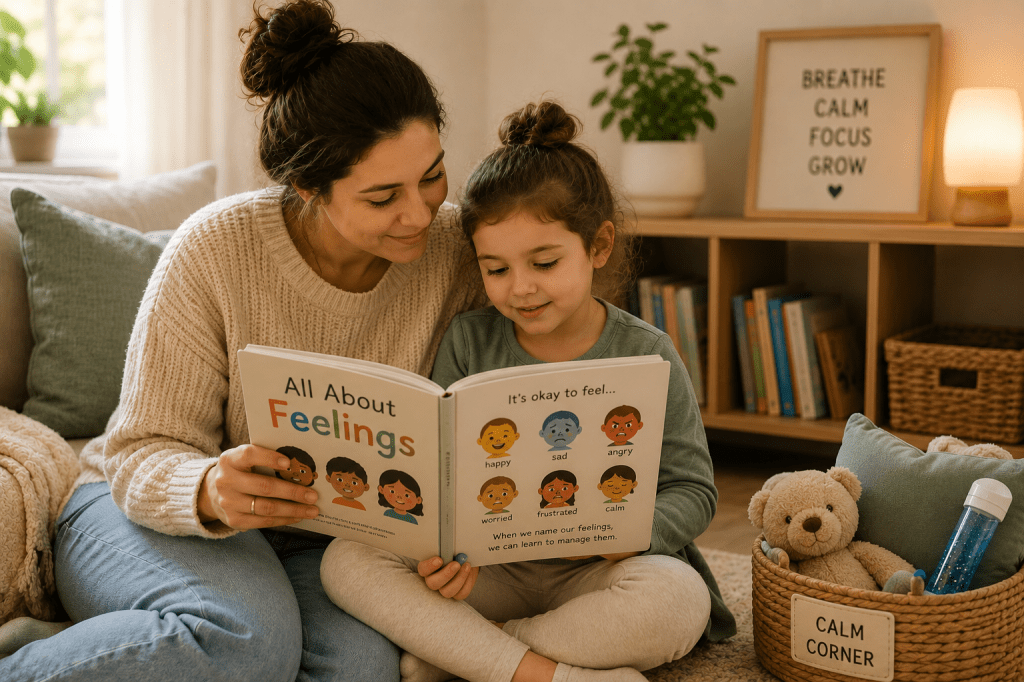
Read Books About Feelings
Stories provide opportunities to discuss emotions in a safe and engaging way.
Books provide children with a safe and meaningful way to explore emotions, understand social situations, and develop the skills needed to manage their feelings. Through stories, children can observe characters experiencing a variety of emotions and learn healthy ways to respond to challenges, disappointment, excitement, frustration, and conflict.
Reading books about emotions helps children build emotional vocabulary by introducing words such as frustrated, worried, disappointed, proud, nervous, and excited. When children can identify and name their emotions, they are better equipped to communicate their feelings and seek support when needed.
Books provide valuable opportunities for discussion and reflection. Parents and educators can pause during a story to ask questions.
Ask questions such as:
- How is the character feeling?
- Why do they feel that way?
- What could they do to solve the problem?
These conversations encourage children to think about emotions, problem-solving, and coping strategies in a supportive environment.
Additionally, many children’s books model healthy emotional regulation strategies, such as taking deep breaths, asking for help, using calming techniques, or expressing feelings with words. Seeing these strategies demonstrated through relatable characters helps children understand that emotions are normal and manageable.
By regularly reading books about feelings and discussing emotional experiences, families and educators help children develop self-awareness, empathy, communication skills, and coping strategies—all of which are essential components of emotional regulation and kindergarten readiness.
Emotional Regulation Is a Skill, Not a Personality Trait
Some children naturally appear more calm than others, but emotional regulation is not something children either have or do not have.
It is a skill that develops through guidance, practice, and supportive relationships.
Every time a child learns to identify a feeling, take a deep breath, ask for help, or recover from disappointment, they are building the foundation for future success.
Final Thoughts
Before children learn to read books, write stories, or solve math problems, they must learn how to manage the emotions that come with everyday life.
Emotional regulation helps children feel confident, build relationships, solve problems, and participate fully in learning. It is one of the most important skills children can develop before entering kindergarten.
By intentionally supporting emotional development at home and in the classroom, families and educators can help children build the confidence and resilience they need to thrive both in school and beyond.
 The Intentional Classroom Co
Leave a comment